King Lewanika’s invitation to the coronation of Edward VII was intended to stabilise British relations with the Barotse nation. Instead, it exposed the cracks in the imperial veneer.
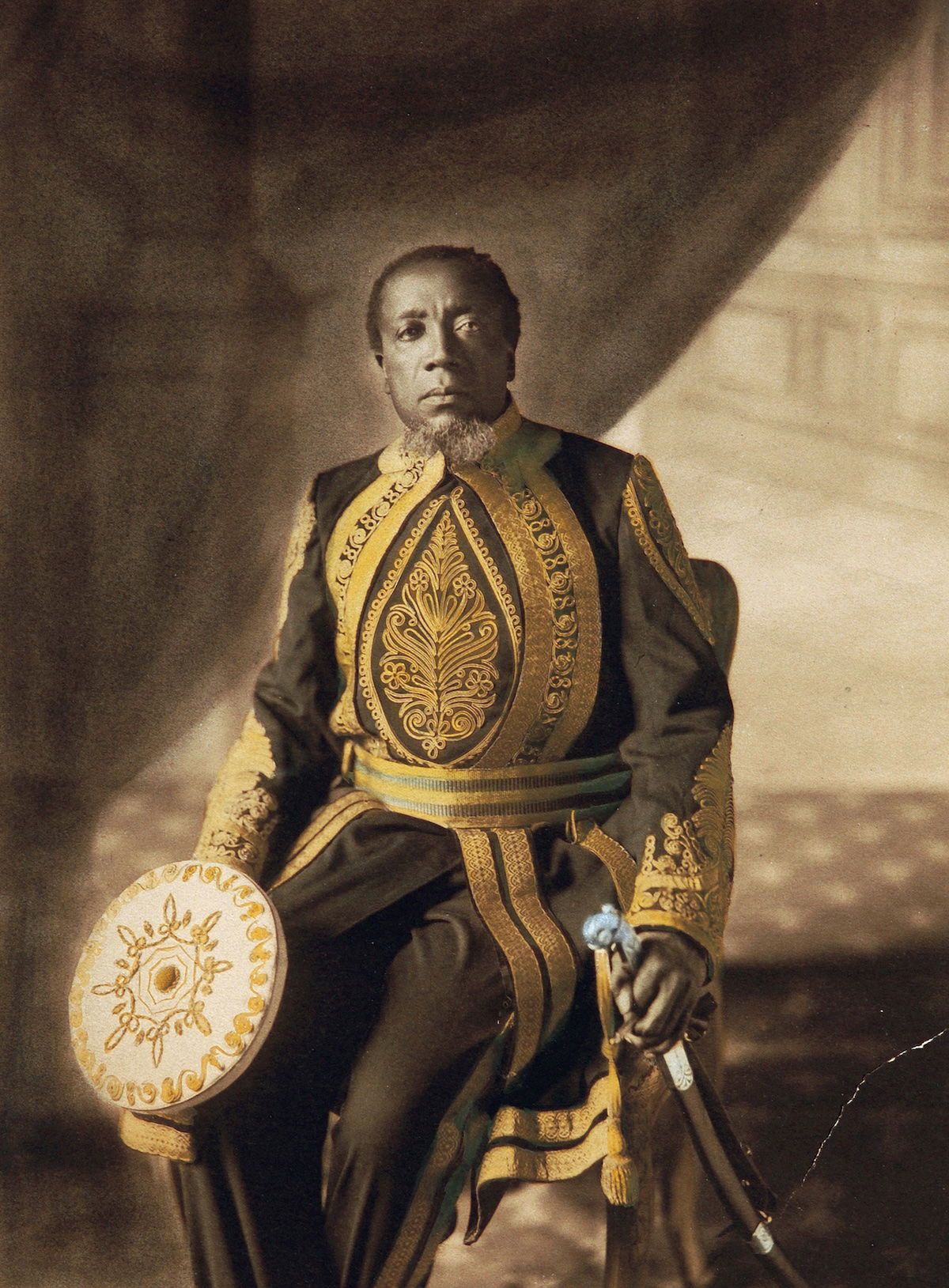
In March 1902 King Lewanika of Barotseland and his entourage took to the Zambezi River on a royal flotilla bound for London. From his capital, Lealui (today in western Zambia), Lewanika began a two-month journey to take his seat at the coronation of Edward VII in Westminster Abbey. He travelled downriver towards the Victoria Falls, overland by oxen-drawn wagon to Bulawayo, by rail to Cape Town, and over sea to Southampton. Arriving in England on 24 May 1902, Lewanika was met by a letter from Joseph Chamberlain, secretary of state for the Colonies:
The King is pleased that you have come so many thousands of miles from your own country to accept his invitation to attend the Coronation, with the representatives of his dominions from all parts of the earth.
That is how the British press and public would see Lewanika’s presence: as a loyal subject from the depths of empire whose journey to the metropole was made to pay homage from himself and his people. Reportage of the visit was extensive. Somewhere between Lealui and London, The Times heralded his arrival:
Register to read more articles for free.
When you register, you will receive the History Today newsletter. Click here to read our Terms of Use.
King Lewanika’s invitation to the coronation of Edward VII was intended to stabilise British relations with the Barotse nation. Instead, it exposed the cracks in the imperial veneer.
In March 1902 King Lewanika of Barotseland and his entourage took to the Zambezi River on a royal flotilla bound for London. From his capital, Lealui (today in western Zambia), Lewanika began a two-month journey to take his seat at the coronation of Edward VII in Westminster Abbey. He travelled downriver towards the Victoria Falls, overland by oxen-drawn wagon to Bulawayo, by rail to Cape Town, and over sea to Southampton. Arriving in England on 24 May 1902, Lewanika was met by a letter from Joseph Chamberlain, secretary of state for the Colonies:
The King is pleased that you have come so many thousands of miles from your own country to accept his invitation to attend the Coronation, with the representatives of his dominions from all parts of the earth.
That is how the British press and public would see Lewanika’s presence: as a loyal subject from the depths of empire whose journey to the metropole was made to pay homage from himself and his people. Reportage of the visit was extensive. Somewhere between Lealui and London, The Times heralded his arrival:
There is no more enlightened or loyal native chief in Africa than King Lewanika. He has placed the whole of his empire, which is much larger than Germany, under British protection, and this is administered by the British South Africa Company.
It was more complicated than that. At the height of its claims in the late 19th century, the Barotse kingdom declared a territory of more than 200,000 square miles, stretching from contemporary Zambia into Angola and Namibia. The British South Africa Company – founded by Cecil Rhodes and given a Royal Charter in 1889, alleging to combine ‘commerce and philanthropy’ on behalf of its shareholders and British imperialism – expected Lewanika’s visit to stabilise diplomatic relations. Lewanika’s amity for the Company had never been established since their first dealings in 1890, when his vision for an entente cordialewith Queen Victoria was seized upon by Rhodes. At that time, Lewanika had just returned from a period in exile (1884-85, following an initial reign from 1878). Facing continued internal dissent by rival factions, the threat of a Matabele invasion from south of the Zambezi, and the encroachments of European imperialism from the west (Portugal) and southwest (Germany), Lewanika sought to follow his neighbour, King Khama III of Bechuanaland, who had established a British Protectorate in 1885. His drive to emulate Khama’s example informed his diplomacy for the remainder of his reign.
Stanford’s map of ‘Africa South of the Equator’, by George Cawston, 1890. Public Domain.
But Lewanika desired a diplomatic relationship between sovereigns, an allyship forged between royals whose right to rule was divine, and was sensitive to the suggestion that Barotseland’s relationship with Britain might be otherwise. While many histories of colonialism centre conquest and dispossession, and others highlight realities of resistance and collaboration, Lewanika was one of the few African statespeople to continuously engage colonialism along diplomatic lines. His attempts to sustain the passivity of potentially hostile powers constitute a striking example of African diplomacy, understood as official, bilateral relations between sovereign states. To understand the significance of Lewanika’s visit, we must look to the origins of his relationship to imperial Britain; or more specifically, his pursuit of a direct relationship with the Crown – at first with Queen Victoria – whose sanctity and power, like his own, were supreme.
Company, Colonial Office, and Crown
Lewanika’s pursuit of a direct relationship with the British Crown on his own terms was frustrated by the greater machinations of what might be styled ‘the British imperial machinery’ and its propensity to present its imperial presence as monolithic. In reality, the relationship between the Company, the Colonial Office, and the Crown (the first subject to the authority of the second, and both to the third) was convoluted. For Britain’s broader imperial interests, all that mattered was that Lewanika’s kingdom could be claimed for the British ‘sphere of influence’ in Africa. It mattered little whether this was secured via Rhodes’ resources or not. To Lewanika, however, it mattered a great deal.
In 1890 the envoy sent to meet Lewanika on behalf of the Company went to great efforts to convince the king and his court that he represented the queen directly. It was a charm offensive, and performances of royal prestige permeated the proceedings. At first, there was little suspicion. Lewanika referred to the envoy, Frank Elliott Lochner, as ‘Messenger to the Great Queen’. Lochner organised a fête in honour of Victoria’s birthday. Cattle were slaughtered, sports played, and there was a firework display. Ultimately convincing, a line in the agreed concession stated that: ‘This agreement shall be considered in the light of a treaty or alliance made between my said nation and the Government of Her Britannic Majesty Queen Victoria.’
Disappointed concession hunters – men who wished to receive rights from African chiefs to prospect their land for minerals, or secure trading rights – soon advised Lewanika that he had been duped. Despite their ulterior motives, they were not wrong. Lewanika swiftly and officially repudiated the concession by formal complaint to the Colonial Office. He requested it be cancelled, stating that the Company’s objectives were not fully explained, and that he was indignant at the agreement’s sweeping nature and its exclusive, monopolistic terms. He wrote
It is because the Company made use of the Queen’s name that they won my consent to make the concession of my country to them.
Lewanika holding a portrait of Alfred Milner, high commissioner for Southern Africa, the Sphere, c.1900. The Sphere. Public Domain.
One resident French Protestant missionary, François Coillard – who had been instrumental in suggesting and brokering British protection – also wrote to the Company in complaint:
What he wanted and still wants, nothing more nor less, is the Protectorate of the Queen’s Government and not that of a mere gold mining company.
Both Coillard’s and the Company’s standing in Barotseland were now at risk, and by extension Britain’s claim to Lewanika’s empire. Henry Loch, then the high commissioner for Southern Africa (the highest British colonial regional authority), sought to reassure Lewanika. ‘You have been wrongly informed’, he wrote, ‘by those who say that Her Majesty’s Government ignore the British South Africa Company.’ This appeased the king momentarily, but from 1890 to the eventual arrival of a promised Resident in 1897 great seeds of doubt were sown. Lewanika had written to the high commissioner in 1894 and reiterated:
My desire has always been to be recognised as one of the Queen’s children and under her own immediate protection. When the Company came, I believed they came from the Great Queen, and because of that I was glad to make a treaty with them. Now many people have come to me. One said, ‘You did right, you are under the Queen’s Protectorate – you are safe.’ But others say: ‘You have done wrong, you have acted foolishly, you have been deceived, you have sold your country and your liberty to a trading Company; you are not under the Protectorate of the British Government as Khama is. What proofs have you that you are?’
Lewanika did indeed lack proof. Fundamentally, the conflation of the Company, Colonial Office, and the Crown in representations of ‘Britain’ in Barotseland failed to veil the fact that Company men were neither government nor Crown. The relationship Lewanika so desired between sovereign rulers was hopelessly indirect. He did not trust the Company, and yet continued to believe in the benevolence of the same monarch who granted its Royal Charter. He remained loyal to the idea of securing a sacred union between monarchs while simultaneously mounting protestations against the Company, who were ostensibly Crown agents. When the first Resident – Robert Coryndon – eventually arrived in 1897, Lewanika was instructed that all communication with the Company and British government should be sent through him. But for a society which did not allow their monarch to deal only with agents and representatives of the Crown, it was befitting Lewanika’s status to communicate not only with Coryndon’s superiors, but directly with Queen Victoria herself.
On record
After his arrival, one of Coryndon’s first tasks was to define Barotseland’s boundaries. This was key, as an Anglo-Portuguese treaty of 1891 had declared that ‘the territory of the Barotse Kingdom shall remain within the British sphere’. The greater this territory was proven to be, the better for both Britain and Lewanika, which could be seen as a kind of co-imperialism. Portugal posed a problem for both through their alleged encroachment into Lewanika’s dominions. By building various ‘forts’ it was feared that the Portuguese could claim ‘effective occupation’ – the term used by European powers following the Berlin Conference of 1884-85 – and so Britain sought to prove that communities at great distance from Lealui recognised Lewanika as a central authority and paid tribute to him.
One official dispatched to investigate the kingdom’s extent was Colin Harding. Having picked up a novel Edison phonograph in South Africa, Harding employed the pioneering technique of playing to distant communities a recorded (and authoritative) voice message from Lewanika himself. Harding wrote that ‘the phonograph here is a great success and wonder’ as he, on Lewanika’s behalf, would ‘take his own “word” and deliver it to his outlying districts – much to their surprise’.
The phonograph would also serve another purpose. ‘The King is very keen that I should send a phonographic message for him to the Queen’, Harding added. While a transcript of the message exists, replete with effusive sentiment – ‘May the Queen long live! May God keep her, and all the Royal Family in peace, – And may the New Year be the happiest of her reign’ – the cylinder itself cracked in transit and Victoria never heard the message. Lewanika’s lament that he had not received any direct communication from Her Majesty fuelled fears of weak royal relations, and drove his desire for proof of the strength of his standing. Lewanika had long lobbied to visit England, as Khama had done in 1895 to petition Victoria against the annexation of Bechuanaland by Rhodes. While he always imagined he would meet Victoria herself in London, it was, ironically, her death that catalysed his visit to the Metropole.
Lewanika photographed in 1902. Michael Graham-Stewart/Bridgeman Images.
At the time of Victoria’s death in 1901 Lewanika’s confidence in the Company and respect for it was at a low ebb. Barotseland’s western boundary also remained undefined, and the longer this prevailed the worse it was for British prestige. Added to this was a new dispute between the Company and Lewanika over whose men would collect a proposed Hut Tax (levied by colonial regimes to tax their subject populations on a per hut, or per household, basis). With these issues live, and with Lewanika’s own lobbying to attend the coronation, arrangements were made.
British officials thought the visit would help mould Lewanika into a model imperial subject, that he would be awed by the power of the British nation. As Coryndon wrote to the high commissioner in 1901: ‘As regards Lewanika’s visit I can see no objection. It would increase his reliance upon us, and might have the effect of accelerating the settlement of the Western Boundary.’ Unlike other recent and politicised visits of African elites – in addition to Khama, Sebele and Bathoen of Bechuanaland and Lobengula of Matabeleland had sent envoys to the queen in 1889 – Lewanika’s visit could be positively spun among the pageantry of the coronation. Lewanika would be a royal guest representing his people. But within this complex set of circumstances, each side leveraged the occasion for distinct political ends. Despite the ostensible celebration of sovereignty – British, African, or otherwise – the visit was underlaid by political dealings.
Lewanika journeyed to London as an agitated man. Nothing had placated the impression that British protection from the highest authority had evaded him, and that he had been treated unfairly by the Company. This was not mere conjecture. Lewanika had grown incensed after being shown in Lealui a passage from E.P. Mathers’ travelogue Zambesia (subtitled ‘England’s El Dorado in Africa’) detailing how ‘two fine tusks of ivory, each considerably over 100lb. in weight, and over six feet long … now ornament the Board Room of the British South Africa Company in their palatial office’. These tusks had been given in 1890 as gifts for Queen Victoria from Lewanika, and their diversion was further proof of Company deceit. It was hoped that the visit would appease Lewanika, who in turn sought irrevocable proof that his relationship with Britain befitted his status.
Man of the moment
Lewanika spent three months in Britain, his movements frequently reported in print. One issue of the Sphere from July 1902 listed Lewanika among their ‘Men of the Moment’ who was ‘having an exceptionally good time of it’ following visits to Henley and the House of Lords. He was a valued guest among the upper echelons of society, attending garden parties alongside global elites. He went to Ascot, a polo match, and an agricultural show. He shopped at Liberty and Harrods, and was entertained at Madame Tussauds and the London Hippodrome. He visited Balmoral Castle in Scotland and became a local celebrity in Yeovil, Somerset while laying the foundation stone of the new premises of the Western Gazette. In Manchester he viewed ironworks diverted to warship and arms manufacture in anticipation of war, being told the weapons were ‘for Germany’. He saw army drills in Aldershot and boarded a gunboat in the Solent to view naval gunner marksmanship in action.
Many vied for his attention, from missionaries to mining magnates; and much of the itinerary was indeed designed to impress British might on Lewanika, but to believe he did not see beyond what he was shown is unrealistic. As the historian Moses Ochonu has observed, ‘colonially sponsored travellers with predetermined itineraries could always veer off scripted paths’. Their travel was ‘fraught with the potential for subversion’ and often led to (or enforced) ‘a consciousness-awakening demystification of the colonizer’.
Newspaper boys holding posters announcing Edward VII’s illness, 1902.. Illustrated London News Ltd/Mary Evans.
The ‘scripted path’ took a further turn when Edward suffered from appendicitis days before the coronation. The ceremony was postponed and many guests returned home. It was not known how long the king would be incapacitated, or if he would survive. But having travelled so far and for so long, Lewanika remained. This unexpected elongation of the trip (ultimately six weeks) was pivotal. Much travel took place during this period. He was further hosted and entertained, his itinerary no longer dictated by formal events; and he gained critical insights into Britain’s political and social landscapes. Crucially, he doorstepped the Company’s offices and confronted the Board over the Hut Tax debacle. The Board supported Lewanika’s authority, but back in Barotseland Coryndon was unaware of the discussion for months, and reversed many of the assurances given to Lewanika in London. This exposed colonial disparities between metropole and periphery which Lewanika could not have failed to notice. As Harding wrote to one of the Board’s directors: ‘Lewanika thinks, and with some reason, that we say one thing in England and act totally differently out here.’
When the coronation did take place in August, many of the foreign delegations which had left in June did not return for the rescheduled ceremony, their countries represented only by ambassadors. Those from beyond Europe – the Katikiro of Uganda, Emperor Menelik of Abyssinia, the Indian maharajahs – all stayed, but it was reported that Lewanika was ‘the only other King at the Coronation’.
Empire work
If the Company and the Colonial Office thought the visit would ‘contain’ Lewanika, it had the opposite effect. He emerged with a greater awareness of the fragmented nature of British imperialism than before. He gained connections within British society to whom he would appeal, alongside greater domestic political strength drawn from having met King Edward himself on 30 May (and a further two times). Only then could he write, as he did to the under-secretary of state for the Colonies (the earl of Onslow) in 1903, that:
My people were greatly pleased to learn that I had personally seen and spoken with His Gracious Majesty King Edward and to know that I and my people will be protected and defended. I shall always remember with pleasure the great kindness I received from many Big Chiefs who I now look upon as my friends who wish me and my people well.
Lewanika would maintain correspondence with people he had met in Britain for years, using it to subvert Company authority. He would later bemoan Coryndon to Onslow and complain about his received percentage of Hut Tax. Lewanika also wrote directly to Alfred Milner (high commissioner for Southern Africa) to lobby Britain to settle the boundary commission. In 1907, after meeting Lord Selborne (who succeeded Milner as high commissioner), Lewanika wrote again to Onslow that he ‘told [Selborne] everything and gave him some papers which he will forward to the Colonial Office. I hope you will then hear my current disagreements with the Chartered Company’. Selborne would be told separately by a Company official that:
since [Lewanika’s] visit to England he is dissatisfied with the sums of money paid over to him by the Company, and is constantly trying to obtain more on one pretext or another, and that, if he could embarrass the Company and get some advantage for himself he would not hesitate to do so.
Lewanika with Director of the British South Africa Company Philip Lyttelton Gell (second from right) and Colin Harding (standing), Langley Lodge, Oxford. Derbyshire Records Office. Public Domain.
At this time, Lewanika certainly had leverage. Despite the imperative to present as a united front, relations between the Colonial Office and the Company were tense. One 1907 letter between Company directors feared they were about to be defrauded by the Colonial Office over affairs in Barotseland:
National gratitude to a Chartered Company that does Empire work is not only non-existent in official circles, but in ‘lieu’ of it, there seems to exist bitter hostility. Cannot we lure [this Colonial Office man] out to Rhodesia and throw him over the Falls Bridge? His head is so thick he is bound to sink.
The meaning of ‘empire work’ in imperial circles was clearly contested. By the time its Charter was revoked in 1924, the first governor of Northern Rhodesia viewed the Company as having ‘symbolised soulless capitalism rather than imperial paternalism’.
The Barotseland issue
Lewanika’s appeals to the Crown and belief in its benevolence may appear naïve, but his motives are clear. He was above all a pragmatist and a diplomat; Lewanika played the Company and the Colonial Office at their own game as best he could, strategically incorporating overtures to the Crown in opposition to the Company.
The power of kingship in Barotseland itself also lent logic to persistent pleas to its British equivalent. Sovereign strength remained sacred and the visit to Britain only reinforced this. Questions of sovereignty permeated Barotseland’s relationship with Britain, which grew ever more complex through to Zambian independence in 1964, and with repercussions to the present. After its amalgamation into Northern Rhodesia in 1911, Barotseland became a kind of state within a state, and retention of its sovereignty became a constant battle for its leadership. Its special status and relationship with Britain led to the Barotseland Agreement 1964 – signed by representatives of Britain, Barotseland, and Zambia – which ostensibly preserved certain rights within an independent Zambia. Kenneth Kaunda (Zambia’s first president) abrogated this agreement in 1969, with the region then demarcated as Western Province. Many members of the Barotse leadership and the community have since campaigned for its restoration, driven by feelings of alienation and underdevelopment. More extreme factions attempted secession in 2010-11. In 2013 Barotseland was admitted to the Unrepresented Nations and Peoples Organization. The ‘Barotseland issue’ continues to simmer with a history traceable back, over 135 years, to Lewanika.
After Lewanika’s death in 1916, his successors and supporters continued to petition the Company and the Colonial Office. His sons also continued to journey from Lealui to London to attend the coronations of British monarchs: Yeta III for George VI in 1937, and Mwanawina III for Elizabeth II in 1953. For state ceremonies in Barotseland itself they continued to wear suits in the same style as the outmoded Victorian ambassador’s uniform gifted to Lewanika in 1902. However, despite the Barotse Royal Establishment’s solicitation of an invitation, the coronation of Charles III in 2023 was the first such occasion for over 120 years that did not count a king of Barotseland among its honoured guests.
Jonathan M. Jackson is a postdoctoral research fellow at the University of Cologne and a research associate at the University of Oxford. He is the author of Visions for an African Valley: Histories of Development in Kilombero, Tanzania since 1877 (James Currey, 2025).