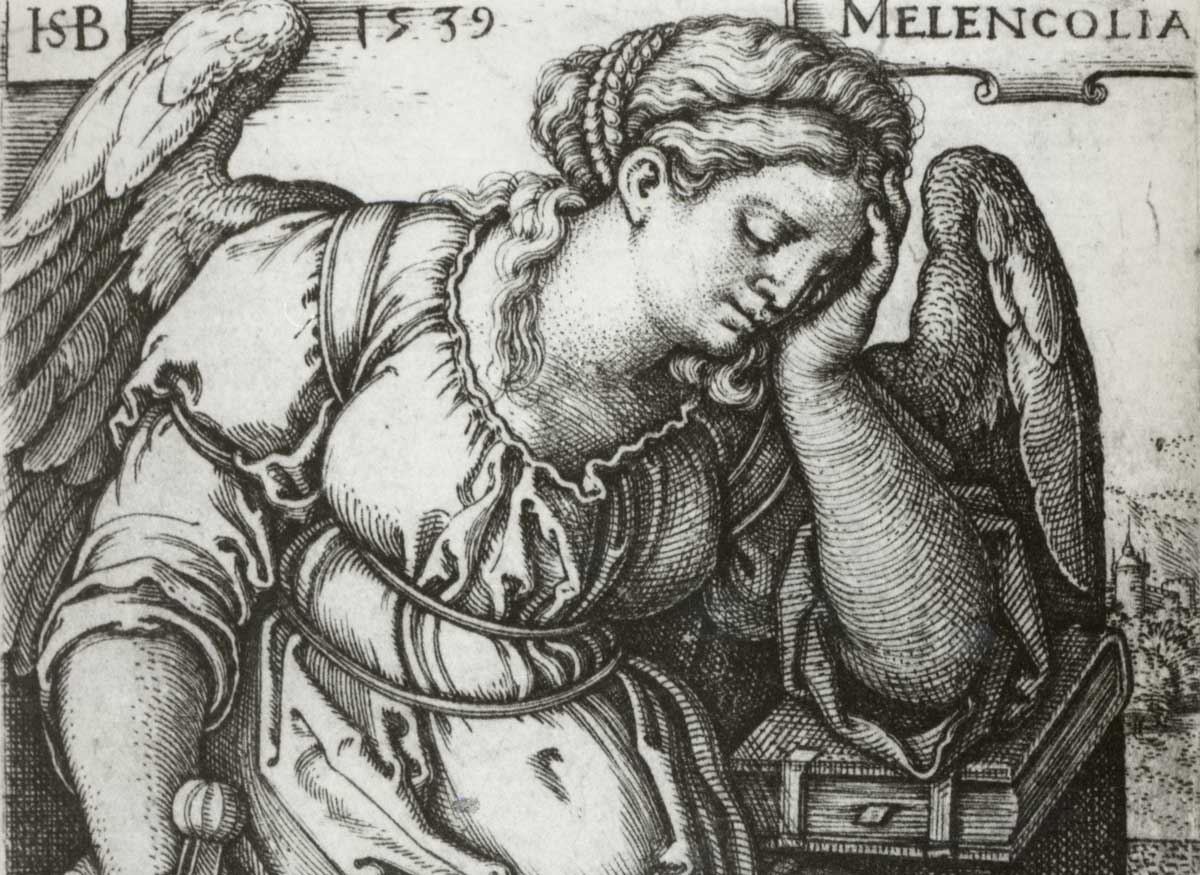
The Oxford scholar Robert Burton completed his first and only book on 5 December 1620. Even as he did so, he was on the defensive, anticipating criticism: ‘I like it, so doth he, thou doest not, is it therefore unfit, absurd and ridiculous?’, he snaps in his Conclusion: ‘One man cannot express what every man thinks, or please all.’
Register to read more articles for free.
When you register, you will receive the History Today newsletter. Click here to read our Terms of Use.
The Oxford scholar Robert Burton completed his first and only book on 5 December 1620. Even as he did so, he was on the defensive, anticipating criticism: ‘I like it, so doth he, thou doest not, is it therefore unfit, absurd and ridiculous?’, he snaps in his Conclusion: ‘One man cannot express what every man thinks, or please all.’
Yet The Anatomy of Melancholy is, in some ways, exactly that: an attempt to ‘express what every man thinks’ on one subject. In the 16th and 17th centuries, melancholy was seen as a mysterious condition of body, mind and spirit. Hard to define, its hallmark features were sadness and fear ‘without any apparent occasion’. By the time Burton began writing about it, he had consulted thousands of volumes in Oxford’s libraries in an attempt to delineate the disease’s contours. In his preface to the Anatomy he even claims to have suffered from it himself and to have embarked on the project as a form of self-therapy.
The result – now celebrating its 400th anniversary – is an encyclopedic work that speaks in a multitude of voices: not just the author’s, but two millennia’s worth of writing drawn from the shelves of medicine, philosophy, history, poetry and theology. The Anatomy is a patchwork or cento (as Burton calls it) of quotations, anecdotes and references. Alongside Galen and Aristotle, we hear from Ovid and Chaucer; the Persian polymaths Avicenna and Rhazes rub shoulders with satirists, papal historians, astrologers, cartographers and playwrights. Burton describes himself, self-deprecatingly, as a reader with a ‘roving humour’:
And like a ranging spaniel, that barks at every bird he sees, leaving his game, I have followed all, saving that which I should, and may justly complain [that] I have confusedly tumbled over divers authors in our libraries, with small profit, for want of art, order, memory, judgment.
His digressive and rambling style is all part of the book’s appeal. When discussing the powers of the imagination, he cannot resist wondering why, when one person yawns, another yawns, too; when exploring the benefits of good air for the sick, he enters a long digression upon whether the Arctic Ocean is navigable and whether other planets are inhabited by aliens. Each idea sparks an association, each opinion he quotes can be followed by another, perhaps even a contradictory one.
The labyrinth
While the structure that Burton’s book takes is that of a medical textbook, examining melancholy through its causes, symptoms, prognostics and cures, the Anatomy bursts these bounds. It becomes perhaps the most inimitable and certainly the most cumbersome of Renaissance literary curiosities: a book that aims not just to examine melancholy, but also, daringly, to turn the mirror back on the reader. For, as the first page of the preface declares: ‘Thou the self art the subject of this discourse.’ With this book we are encouraged to trace our own predispositions and weaknesses and to find our cures for melancholy.
Just as the Anatomy turns to the reader, so it reveals something of the author. Burton tells us that, as a victim of ‘mistress Melancholy’, he has been compelled ‘to ease my mind by writing’. That sense of being unable to stop himself from writing is supported by the Anatomy’s print history. When it was first published in quarto format in 1621 the book was 350,000 words long. Three years later an expanded edition appeared, this time in folio. By the time of Burton’s death in 1640 three more editions had appeared, each longer than the last (he rarely deleted a word). He even left behind him a final, sixth edition, eventually published 11 years after his death. By that time his attempt to have the final say on melancholy had reached over half a million words. In a sense the Anatomy was never truly completed and perhaps Burton would have had even more to say had he lived beyond his 62 years.
Burton’s The Anatomy of Melancholy. Engraving by C. le Blon, London, 1676. Courtesy Wellcome Images.
The growth of The Anatomy of Melancholy reflects the proliferating nature of the disease itself, for Burton warns that the chronic condition of melancholy creeps up slowly until its spread is unstoppable. One might start by enjoying one’s own company, staying in bed late, avoiding the company of others and going for solitary walks. Then, a little later, ‘a most incomparable delight it is so to melancholise, and build castles in the air, to go smiling to themselves, acting an infinite variety of parts, which they suppose and strongly imagine they represent’. So these ‘fantastical and bewitching thoughts’ take hold
so covertly, so feelingly, so urgently, so continually set upon, creep in, insinuate, possess, overcome, distract, and detain them, they cannot, I say, go about their more necessary business, stave off or extricate themselves, but are ever musing, melancholising, and carried along, as he (they say) that is led round about a heath with a Puck in the night, they run earnestly on in this labyrinth of anxious and solicitous melancholy meditations, and cannot well or willingly refrain, or easily leave off, winding and unwinding themselves, as so many clocks ...
Burton’s language echoes the condition: words heap up as he reaches for a synonym or a parallel clause. His syntax winds and unwinds as he reveals the entrapping mental experience of ‘melancholising’.
Democritus the anatomist
Although Burton claims that his knowledge comes from personal experience, he speaks from behind the mask of Democritus Junior. This pseudonym marks him as heir to the Greek philosopher who laughed at the world’s universal folly (unlike Heraclitus, the philosopher who instead wept). Burton recounts how the people of Abdera sent for Hippocrates because they feared that Democritus had lost his sanity. The physician found the philosopher in a garden strewn with the carcasses of dissected animals. When Hippocrates asked him what he was doing, Democritus replied that he was looking for the source of the melancholy madness that appeared to afflict the whole world. Since it was not socially acceptable to dissect humans, he searched for clues in the bodies of animals instead. Thus Democritus was the original anatomist of melancholy.
Ancient theories of melancholy locate the condition firmly within the body. The humour melancholy – black bile – is one of the four fluids that maintain life, along with yellow bile, blood and phlegm. When one humour grows excessive or becomes ‘adust’ (burnt or corrupted), a previously healthy person succumbs to chronic sickness. Mind and body work upon one another. Through the excess of black bile or through the corruption of the other humours, vapours produced in the body can ascend to the head. There, they affect the brain’s workings and inhibit the sufferer’s ability to reason.
These vapours might even interfere with the senses, causing someone to see something that is not there or distorting what is. Since melancholy is a black humour, it might induce dark figures. (Renaissance melancholics reported seeing black-robed monks or soldiers in black armour.) Burton explains the optical theory behind this:
As he that looketh through a piece of red glass judgeth everything he sees to be red, corrupt vapours mounting from the body to the head, and distilling again from thence to the eye, when they have mingled themselves with the watery crystal which receiveth the shadows of things to be seen, make all things appear of the same colour, which remains in the humour that overspreads our sight, as to melancholy men all is black, to phlegmatic all white, etc.
What is happening within the bodies and minds of melancholics projects outwards onto the world around them. Melancholics see a darkness – in a literal sense.
Curing melancholy
While irrational ideas and self-perceptions might produce outlandish behaviour, melancholy might also take hold in less visible, but far more damaging ways. Renaissance physicians understood that treating melancholics was not merely a matter of persuading them; diseases of the mind would not yield to well-meaning advice. As Burton puts it: ‘You may as well bid him that is diseased not to feel pain, as a melancholy man not to fear, not to be sad: ’tis within his blood, his brains, his whole temperature, it cannot be removed.’ How then to treat them?
The Anatomy of Melancholy affirms a Hippocratic approach to treating illness by carefully observing each individual patient’s state. To cure this Protean disorder, in which ‘scarce two of two thousand ... concur in the same symptom’, a physician must first read the melancholic’s habits and temperament, as well as how the illness came about. For example, one sufferer might find her sorrowful spirits lifted by music, which Burton describes as a ‘roaring-meg against melancholy, to rear and revive the languishing soul; affecting not only the ears, but the very arteries, the vital and animal spirits’. On the other hand, someone suffering from the variety known as ‘heroic’ (love) melancholy might get worse rather than better if exposed to music, given its associations with romance. And, since melancholics tend to become excessively preoccupied with a single thing, a tune may catch their attention so strongly that ‘the sound of those jigs and hornpipes will not be removed out of the ears a week after’. Or it can inflame their minds to dangerous levels; Burton warns that ‘music makes some men mad as a tiger’. All treatments need to be carefully calibrated to the patient’s temperament and tendencies.
To treat melancholy successfully often involves entering the melancholic’s state of mind and seeing through their eyes. This is especially the case for those who suffer from delusions. The textbooks of Renaissance melancholy record many strange stories of cures enacted through elaborate and even theatrical means. In one of the most famous cases, a gentleman in Siena became convinced that, if he urinated, his town would be drowned. Burton found the story in the writings of the French physician André du Laurens, who explained how the man’s physicians relieved him by tricking him. First, they started a controlled fire in the house next door and had the church bells rung by way of fire alarm. Then, as the servants shouted for help, the civic worthies came to seek the patient’s aid. They pleaded with him ‘that there is but one way to save the town, and that it was, that he should piss quickly and quench the fire’. The result was instant success: ‘This silly melancholic man which abstained from pissing for fear of losing his town, taking it for granted, that it was now in great hazard, pissed and emptied his bladder of all that was in it, and was himself by that means preserved.’
Perhaps it is Burton’s eye for gathering such fascinating stories, his skill in piecing together quotations from others to form a greater whole, that explains why The Anatomy of Melancholy continues to attract readers 400 years after its first appearance. It is also melancholy itself that draws our attention: an ancient condition that finds its echoes in our modern understandings of mental health, but also evades easy categorisation. Melancholics might be sorrowful and fearful, but they might equally be prone to fits of hilarity, or convinced they see demons; susceptible to religious superstition, or infatuated with an unsuitable person. While the Renaissance disease of melancholy was a fit subject for the pen of a physician, Burton (who had no medical training) took melancholy as an emblem of a far more essential truth. It is, he writes, ‘the character of mortality’. All of its readers fall within the book’s compass, as no one is entirely safe from melancholy’s irresistible force.
Mary Ann Lund is Associate Professor in English at the University of Leicester and the author of A User’s Guide to Melancholy (Cambridge University Press, 2021).