

Dracula: Fact, Legend and Fiction
Dracula, the vampire that haunts our dreams, is the one created by the 19th-century author, Bram Stoker: but, as Paul Dukes explains here, there is a basis in fact and eastern European legend for the ghoul.
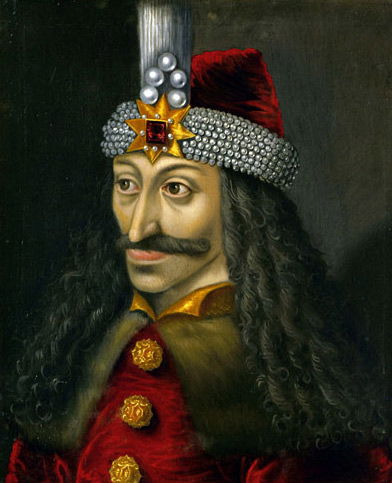
First the fact, although as anybody who has ever investigated the life of an historical personage will know, this is by no means easy to establish. Dracula did indeed live, but who was he, and how did he acquire his reputation?
In Romanian history today, he is best remembered as a leader in the medieval struggle against the Turks. From 1456 to 1462 and again briefly in 1476, the ruler of the Daaubian principality of Wallachia was Vlad Tepes, that is Vlad the Impaler, alias Dracula. Six years after the fall of Constantinople in 1459, this valiant prince refused to pay tribute to the Ottoman Porte, and a further two years 'later, he led an army across the Danube to take the fight to the enemy, allegedly killing 24,000 Turks and liberating some of the territory recently occupied by them. But then, in 1462, Sultan Mohammed II the Conqueror in person led a campaign of retaliation against Wallachia. Vlad put up a spirited resistance, and was finally overcome not in the field of battle but by the duplicity of the King of Hungary, Matthias Corvinus (1440-1490), to 'whom he had appealed for support but by whom he was now imprisoned. In 1476, he managed to escape to take part in the fight against Ottoman encroachment in Bosnia and to reoccupy the throne of Wallachia. However, in the same year, as a Romanian account puts it, 'this unyielding fighter for the freedom of his people was killed in a campaign against the Turks'.
The Romanian view, hardly surprisingly, has not been shared by others in eastern Europe; Hungarians, to take the most obvious example, do not regard Matthias Corvinus as a double-dealer. Nor, more importantly, have they looked upon Transylvania, the land of Dracula's birth, as part of a single country along with Wallachia, the land over which he ruled, persisting to this day in their belief that Transylvania should be part of Hungary. Germans have tended to follow the view of their fifteenth- century forefathers in the Holy Roman Empire who invested Dracula's father with the hereditary Order of the Dragon only to regret it, believing that the family so honoured soon proved itself, in the shape of the son, unworthy of such a chivalrous award. The name Dracula could mean both 'son of the dragon' and 'son of the devil', and in German eyes the latter interpretation quickly came to predominate. Meanwhile, in Orthodox Russia, by 1490 a version of his career was in manuscript according to which Dracula was to be condemned for his apostatical acceptance of Roman Catholicism during the years of his imprisonment in Hungary, but also to be approved of for his cruel but just policies. Without entering into the historical controversy, the Soviet scholar Ian Lurye has given perhaps the best description of it.
Just a few years after his death, then, assessments of Dracula were being put forward which already coloured the 'fact' and contributed to the legend which was to lead in turn to the fiction. Other components of the legend were many stories, one of the most recurring of which tells of a visit to the prince by some ambassadors who entered his presence without removing their hats, giving the explanation that such was the custom with them. Dracula ordered their hats to be nailed to their heads with the explanation that this would strengthen their custom and, in some versions, that their rulers would in such a manner learn that in Wallachia it was best to behave as the Wallachians. Another oft-told tale concerns the perpetration of enforced cannibalism, sometimes as gypsies are made to eat each other, on occasion as mothers are commanded to roast their babies and then eat them. The most frequent subject of the Dracula legend, however, is connected with his alternative nickname Vlad the Impaler. For example, a person complaining about the stench emanating from a number of corpses already impaled is himself hoisted on a stake to where the air is sweeter. Much of the transfixion seems to be without clear purpose. If there is some dispensation of justice, it is rough in the extreme, and the abiding impression is of a gratuitous sadism alleviated, if at all, by a sardonic sense of humour. If the legend reflects fact, times must have been very hard indeed for the fifteenth-century inhabitants of Wallachia and other nearby principalities.
The life style of the most famous fictional creation is totally absent from the legend. The distinctive characteristics of Bram Stoker's monster could stem partly from the circumstance that the words 'devil' and 'vampire' are interchangeable in several languages, while belief in vampires has been very widespread and still exists in Dracula's homeland and other parts of eastern Europe, not to mention the wider world. More directly, Bram Stoker is said to have received his version of the life and living death of his 'hero' from, among other sources, Professor Arminius Vambery, a well-travelled scholar from Hungary with whom he dined at the Beefsteak Club in London in 1890. Probably, in the course of the conversation, the exploits of Vlad the Impaler were mentioned, and if so given their characteristic Transylvanian setting, but it is possible that the connection between the Professor and Dracula was made in the mind of Stoker and others by the juxtaposition in several encyclopaedias of 'Vambery' and 'vampire'.
Certainly, there was no shortage of influences on the novel that was to appear in 1897. Born fifty years earlier in Dublin, and a graduate of Trinity College, Bram Stoker had switched from a routine Civil Service job (his first publication bearing the unpromising title of Duties of Clerks of Petty Sessions in Ireland ) by way of part-time literary activity and dramatic criticism to stage management for the actor Sir Henry Irving, combined with the development of his own pursuit of the profession of letters. A considerable impression had been made upon him by Carmilla , the vampiric novel by his fellow Dubliner Joseph Sheridan Le Fanu, and his own first imaginative work contained a character called 'the phantom of the fiend'.
The nineteenth century was, of course, no stranger to vampires and fiends of many varieties. Mary Wollstonecraft Shelley took the Gothic novel to a new level of realism with her Frankenstein (1818). Byron, Goethe and Alexandre Dumas the father were just a few of the more famous writers to show an interest in the posthumous consumption of blood. And among the many interesting people that Stoker met in the course of a busy life was Sir Richard Burton, the famous traveller and translator, from whom he learned of Arabian and Indian vampires and who also impressed him with the prominence of his canine teeth. Then, in the autumn fog of 1888 in the streets of London, reality overtook legend and fiction in the shape of Jack the Ripper, who aroused in the popular press all kinds of images of blood- sucking creatures from the 'Dark Ages' and gave further fuel to Stoker's already well-lit imagination. Two years later came the meeting with Professor Vambery, supplemented by research in the Reading Room of the British Museum, which had recently acquired a German pamphlet printed in 1491 and relating some of the horrific stories about Dracula.
Further hypotheses concerning the sources of Stoker's novel range from the dim and distant past to the most immediate and personal present. During his childhood in Ireland the author had heard many tales of Celtic mystery and imagination, augmented by his mother's personal reminiscences of some of the more macabre aspects of the cholera epidemic of 1832. In 1894, Stoker made the first of many holiday visits to the north-east Scottish fishing village of Cruden Bay, where he was able to absorb more Celtic folklore of both genuine and artificial varieties. It is possible that he learned there of The Vampire: Bird of the Isles , published in London in 1822 and set in the Western Isle of Staffa. And a local authority, James Drummond, has written not only of the Stoker association with Cruden play but also of a palpable influence from another Scottish play, indeed nothing less than the Scottish play, which superstitious actors still shrink from calling by its proper title. Drummond points out many parallels between Macbeth and Dracula culminating in the respective dénouements :
The armies of outraged virtue close in to sweep aside the forces of evil and to exact retribution. The Cross of St. George and the Crucifix, the fresh green growth of Birnam Wood and the clean, sharpened stake of rowan. And finally, the ancient cathartic Celtic ritual of the severed head releases the world from the reign of evil. "Behold where stands the usurper's cursed head!" cries Macduff, "The time is free!" And Morris dutifully echoes, "See the snow is not more stainless than her forehead. The curse is passed away!"
As far as Scottish connections are concerned, it may be worth adding that some of the tales heard by Stoker at the Bay of Cruden (one of whose suggested derivations appropriately means 'blood of the Danes') could well have been similar to others told in the Carpathian Mountains, in the neighbourhood of which the Celtic peoples are said to have had their origins long before the birth in Transylvania of Vlad the Impaler. Moreover, recent critics of the book on Robert Seton-Watson by his two sons, have pointed out how the great man's sympathy for the peoples of Transylvania and other Carpathian regions might well have stemmed from his own Scottish background, an affinity which could have permeated a generation or so earlier as far as the author of Dracula . Certainly Stoker himself wrote of his researches: 'I read that every known superstition in the world is gathered into the horseshoe of the Carpathians, as if it were the centre of some sort of imaginative whirlpool'.
Finally, a most intimate source of Stoker's inspiration has been mooted by Penelope Shuttle and Peter Redgrove in The Wise Wound: Menstruation and Everywoman . In Chapter 7, which they entitle 'The Mirror of Dracula', they write:
'Stoker was married to the beautiful Florence Balcombe, who was much admired by Oscar Wilde, and who was also, according to authorities, frigid as a statue. It is likely that a woman with an unsatisfactory sex life will also have very bad menstrual disturbances. Was it some image of these that gave Stoker's subliminal mind the hint that formulated a myth of formidable power, out of the ferocity of a frustrated bleeding woman, crackling with energy and unacknowledged sexuality?'
From the mists of Celtic antiquity to the pattern of his marital problems is probably a long way towards a comprehensive understanding of Stoker's imagination, yet there are still a few further comments to be made on the contents of the novel itself. We now move into a local history contest, Cruden Bay versus the North Yorkshire seaport of Whitby. Bram Stoker took his summer holiday of 1890 in Whitby just a few months after his meeting with Professor Vambery and, according to local legend, derived the idea for his book from a bad dream following a crab supper. Dracula , it is well authenticated, was actually begun a few years later in Cruden Bay, but the Count's arrival in England is explicitly set in Whitby, with Stoker drawing on some of his earlier holidays there at the same time as copying certain details from the more immediate locale. Whitby Abbey might well have merged in his mind with Slains Castle perched on a cliff near Cruden Bay as he came to depict Dracula's residence. Describing the closes of Whitby, he talks of 'wynds, as they call them in Scotland.' And some of the words that he puts in the mouth of the North Yorkshire fishermen are taken from the Buchan dialect of North-East Scotland: 'to skeer an' scunner hafflins' for example, which means 'to frighten and disgust young boys'. That Stoker found Cruden Bay the more congenial place for literary activity is indicated by the fact that he wrote two novels almost completely set in and around it, The Watter's Mou and The Mystery of the Sea . On the other hand, the storm heralding Count Dracula's arrival on English shores, one of the more powerful descriptive passages in his most famous work, was definitely drawn in large part from experiences undergone by the fishermen of Whitby just about the time of Bram Stoker's holiday in that seaport.
On its publication in 1897, Dracula was well received by the critics, the Daily Mail , for example, considering it 'even more appalling in its gloomy fascination' than such works as Frankenstein , Wuthering Heights and The Fall of the House of Usher . However, the book was not a best-seller, while its first dramatised appearance, hastily put together to protect the author's copyright, was allegedly deemed dreadful, in no flattering sense, by no less a person than Sir Henry Irving himself. Nevertheless, it was through a later presentation on stage that Dracula achieved the fame that it enjoys today. Opening in Derby in 1924, the new play later transferred to a successful run in the Wear End. Then, on Broadway, the leading part was played by the Hungarian Bela Lugosi, who went on to use his authentic east European accent in the first 'talkie' film version of 1931. This achieved wide success and there have been many cinematic recapitulations and variations of the basic Dracula theme – over four hundred, according to one calculation. The dreaded name has been applied in all kinds of directions, most bathetically perhaps in an ice-lolly advertised as "Count Dracula's Deadly Secret – Eat One Before Sunset!' Undoubtedly, a prominent place in the general western, even world consciousness, has been won by Bram Stoker's creation.
For it is that, rather than the historical figure, which we all now know and fear. True, versions of the old legend, themselves perhaps now far removed from the authentic life of Vlad Tepes, are still related by Romanian peasants, and may not have disappeared from pre-industrial folklore elsewhere. But Dracula's grasp seems to be most firmly via the novel on sophisticated anxieties of city dwellers, lonely anonymity and psychological disturbance, sexual repression and frustration particularly. In some way or another, the monster has sunk his teeth into everybody.


