

The Pilgrimage Origins of the First Crusade
To be a pilgrim - a choice that led not to contemplation but to holy war in the climate of 11th century Europe. Marcus Bull asks why.
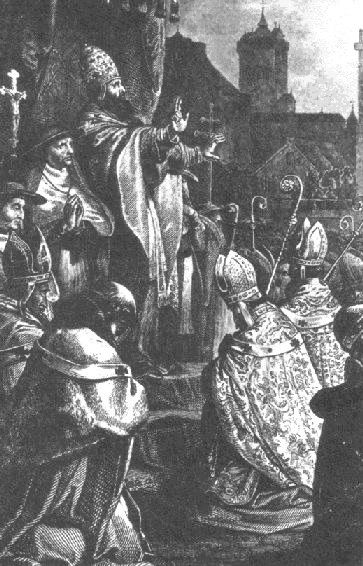
On November 27th, 1095, at Clermont in central France, Pope Urban II delivered the sermon which launched the expedition now known as the First Crusade. He called on the faithful, in particular the lords and knights who formed society's military élites, to relieve the oppression of Eastern Christians and to liberate the Holy Places by means of an armed pilgrimage, participation in which would earn remission of one's penances because of the great hardships which would be faced. The pope's message was bold and challenging, and it received an enthusiastic response; according to Robert the Monk, one of the chroniclers who described the scene, everyone shouted 'God wills it!' once Urban stopped speaking.
Why was this speech important? Urban was a good communicator, but what he said was as much a briefing as a piece of oratory. His audience mostly comprised bishops and abbots who had assembled some days earlier for a church council. Not many lay people were present, and only a small minority of those who went on the crusade could claim that they had heard the Clermont speech. Nor was Urban's message a one-off, for it was repeated many times in the following months by the pope himself and by other churchmen. Many people learned about the crusade from popular preachers and through other unofficial channels. So the pope's initial speech was just one small part of a much wider recruitment effort. None the less, contemporaries soon came to remember Urban's sermon as a great defining moment; the myriad complexities of the preaching and organisation of an expedition which involved tens of thousands of people from many parts of Europe could be understood more easily by focusing on the rousing events at Clermont and the emotions they released.
This makes it all the more frustrating for historians that it is impossible to know precisely what Urban said. A number of accounts of his speech survive, some of them by members of his audience, but they were written a decade or more later and were influenced by the authors' knowledge of how events unfolded after Clermont, in particular how the crusaders captured Jerusalem in 1099 after a remarkable three-year campaign. The best way to reconstruct Urban's message, therefore, is to examine the ideas and images which he used to excite his audience. After all, the crusade needed careful presentation. Urban was proposing a novel idea to a generally conservative society. He was also asking people to volunteer to do something which was very expensive, time-consuming, arduous and dangerous. What he told them, then, had to be direct and vivid.
Two ways to win over an audience are to conjure up bold, easily visualised images and to tap into deep-seated emotions. Urban used both techniques skilfully. He described a state of crisis in the eastern Mediterranean: the Byzantine Empire was in retreat; churches were being defiled and polluted by infidels; Christians were being subjected to horrible persecutions including rape, torture, mutilation and murder. The Muslim aggressors were portrayed as wantonly cruel: according to Robert the Monk, Urban claimed that Christians were being tied to stakes so that they could be used for archery target practice. The particular villains of the piece were the Turks, nomadic warrior bands with roots in central Asia who had been extending their power into Asia Minor, Syria and Palestine since the 1070s. Of particular concern was their treatment of Jerusalem, which Urban reminded his listeners was the holiest place known to Christians.
Urban had almost certainly never been to the Holy Land himself, and what he said owed more to rhetoric than reality. His depiction of the sufferings of Christians, with its lurid details of torture and pain, resembled contemporary ideas about what it was like to suffer in Hell. It is possible that the Turks, as newcomers to the western Fertile Crescent and its complicated religious history, were sometimes hostile to the Christians living in their domains. But their treatment seldom, if ever, amounted to the sort of horror stories which Urban re-counted. Nor was the composition of the Muslim world as straightforward as the pope's message implied. In fact the Turks lost control of Jerusalem to the Egyptians in 1098, a year before the crusaders arrived: it is a curious irony that the enemies faced at the climax of the crusade were not those whom Urban had originally envisaged.
Most Westerners' understanding of the politics and peoples of the Middle East was vague at best, and Urban exploited this. His aim was to instil the feeling that there was something gravely wrong, dirty and dishonourable about the plight of the Holy Land. This was a substantial achievement: such a sense of urgency comes through in the accounts of Urban's speech that it is easy to lose sight of the fact that Christians had not controlled Jerusalem since the Arabs captured it from the Byzantines in 638. Yet Urban was able to present a long-term fact – 457 years of uninterrupted Muslim rule – in terms of a pressing injustice against God and His people. This was the key reason for the success of his message. Why?
An important clue is contained in the version of Urban's speech written by the contemporary chronicler Guibert of Nogent. Having described at length the important role which Jerusalem had played in history and would play at the Last Judgement, the pope asked his audience to consider the plight of those who went on pilgrimage to the Holy Land. The richer among them, Guibert has Urban say, were subjected to violence at the hands of infidels; they were also forced to pay heavy tolls, taxes, entry fees to get into churches, and bribes. The poorer pilgrims were badly mistreated by locals trying to get money off them at any cost. 'Remember, I urge you', the pope said, 'the thousands of people who have died horribly and take action for the Holy Places'. This is rhetorical exaggeration, but there is also an underlying idea that Jerusalem meant something very real to Western Europeans.
Perhaps Urban did not actually dwell on the troubles of Westerners going to the Holy Land as much as this – other accounts of the speech focus more on Eastern Christians – but Guibert was right to suppose that mentioning pilgrimage was an excellent way to evoke a sympathetic response in an audience. Jerusalem was a distant, exotic place, but it was also within the bounds of many people's experience. Monks sang about it daily in their psalms. Relics of the True Cross and other physical re-minders of the Holy Places were to be found in many European churches. And significant numbers of people had been to the East themselves. Jerusalem was, paradoxically, both far away and familiar.
By linking his crusade message with Jerusalem pilgrimage Urban was cleverly tapping into a long-established feature of Christian religious practice. Some churchmen had reservations about the value of pilgrimage, doubting whether the faithful could earn greater spiritual merit in some places rather than others. It was also argued that travelling to the actual Jerusalem was less important than striving through prayer and good works to enter the celestial Jerusalem, the community of the blessed in Heaven. But such detached attitudes were a minority view. Enthusiasm for relics and sites associated with saints was widespread among both clergy and lay people. More specifically, interest in the humanity of Christ – an emerging feature of 11th century spirituality and devotion – focused attention on the Holy Land, which was in a sense one huge relic sanctified by Christ's presence.
The emotional appeal of Jerusalem in particular could be enormous. This is clearly illustrated by the behaviour of Richard of Saint-Vanne, an abbot who arrived on pilgrimage on Palm Sunday 1027. Throughout Holy Week he busied himself visiting places associated with Christ's life, Passion and Resurrection. He would regularly throw himself on the ground in prayer, sobbing and crying. According to his biographer, seeing the pillar where Christ was scourged and Calvary where he was crucified reduced Richard to floods of tears. So strong was his attachment to the Holy Sepulchre that when an Arab threw a stone which bounced into the shrine, Richard kept it as a treasured relic.
Richard was able to find and be moved by the scenes of the Passion and other holy places largely because of building work done by the Byzantines many centuries earlier. Interest in Jerusalem had blossomed in the fourth century, when Constantine the Great (306-37) recognised Christianity as an official religion of the Roman Empire. Sites familiar from the Gospels were identified by drawing on the traditions of Christian communities in Palestine and through architectural detective work: for example, Christ's tomb was reckoned to be beneath a pagan temple built in the second century by Emperor Hadrian.
As the holy topography of Jerusalem became established, Constatine began an ambitious construction programme, the centre piece of which was a collection of buildings containing Calvary and the Holy Sepulchre. To these was later added the site of where Constantine's mother Helena was believed to have found the cross used at the Crucifixion. Over the next 300 years emperors and other rich benefactors continued Constantine's work, turning the city and nearby places into an impressive complex of churches, monuments and shrines. Jerusalem was not an important mercantile or industrial centre, and its agricultural hinterland was not particularly rich. Much like Rome in later centuries, its prosperity came to be based largely on its churches and the visitors attracted by them, among whom were Western Europeans.
The flow of Western pilgrims to the Holy Land was disrupted by the Arab conquests in the seventh century and later by unsettled conditions within Europe as political conflicts and the depredations of Vikings, Arabs and Magyars made long-distance travel difficult. But interest in Jerusalem survived, and the journey there was still made by some hardy souls such as the Anglo-Saxon St Willibald in the 720s and a Breton monk named Bernard in about 870. The fact that Jerusalem was never forgotten was important, because it meant that the numbers of pilgrims grew quickly once conditions became more favourable in the years either side of 1000.
Hungary was converted to Christianity, and the Byzantines extended their power in the Balkans and Asia Minor. This meant that travelling to Jerusalem entirely by land, slower than going some of the way by sea, but cheaper and open to more people, became a practicable proposition. What had earlier been a pious adventure for an élite few could now exert a wider appeal. This important change is memorably described by the Burgundian chronicler Ralph Glaber. Writing of the time around the millennium of the Passion (1033), Glaber reports that an 'innumerable multitude from all over the world began to flock to the Saviour's sepulchre in Jerusalem'. Swept up in the excitement, he says, were men and women, lowly people, those of middling status and also nobles and bishops.
By the time that Glaber's pilgrims were going to Jerusalem, the city had changed a great deal from its Byzantine heyday. In 1009 the Fatimid caliph al-Hakim, who was possibly mad, ordered that the church of the Holy Sepulchre and other Christian places in and around Jerusalem be razed to the ground. There was widespread destruction: when the crusaders arrived ninety years later they found many churches still deserted or ruinous. But the worst of the damage was eventually halted. After al-Hakim died in 1021 his successors were more moderate. The Muslims could sympathise with the idea of pilgrimage because of their experience of the Hajj, the journey to Mecca. And Jerusalem was a holy place in Islamic tradition: the Dome of the Rock had been built in the late seventh century on the site from where it was believed Muhammad had ascended into Heaven.
On a more practical level, pilgrim traffic was an important economic resource which could be exploited through tolls, taxes and markets. Consequently the Byzantines were allowed to restore some of the major Christian sites. The complete reconstruction of Constantine's precinct was out of the question, so the rebuilding effort was concentrated on the Anastasis, the rotunda containing the shrine built over Christ's tomb. This structure was later incorporated within the imposing church of the Holy Sepulchre which the Franks constructed in the 12th century, and parts of it are what pilgrims see today (though extensive rebuilding was undertaken after a serious fire in 1808).
It is impossible to know how many Western pilgrims went to the Holy Land in the decades before the First Crusade. Certainly there were fewer than during the 88 years (1099-1187) when Jerusalem was in Frankish hands: this was a boom period when many tens of thousands made the journey. But the numbers of 11th century pilgrims were none the less substantial. There seem to have been peaks of activity once or twice in every generation, but there would also have been departures every year. We have most information about pilgrimages by members of the aristocracy. They could most easily afford the expense of a long journey, and they were less tied to the land than the majority of the population. One notable pilgrim was Count Fulk Nerra of Anjou (987-1040) whose nickname 'the Black', belies the fact that he was a great enthusiast for Jerusalem, going there at least three and probably four times.
A good illustration of the appeal of Jerusalem pilgrimage to the European nobility is how closely it touched the lives of the three leading figures in the well-known events of 1066. King Harald Hardrada of Norway, whom Harold of England defeated and killed at Stamford Bridge less than three weeks before the Battle of Hastings, had been to the Holy Land many years before while serving the Byzantines as a Varangian mercenary. One reason why Harold Godwinson was the foremost English contender for the throne in 1066 was the fact that his elder brother Swein had died some years earlier. A violent and unstable man with many sins to repent, including the murder of his cousin Bearn, Swein had gone bare-foot on a penitential pilgrimage to Jerusalem in 1052 and had died on the return journey. Accounts of how he met his end vary: he may have been waylaid by bandits, or he may have died of exposure in Asia Minor.
The life of William the Conqueror, too, was affected by Jerusalem pilgrimage. His father, Duke Robert I of Normandy, travelled to the Holy Land in 1055 and died at Nicaea in Asia Minor on the journey home. His heir, William, was only a young boy, and the weakening of ducal authority plunged Normandy into years of turmoil. The obstacles which William encountered in restoring order and the enormous dangers he faced – many of those close to him were cut down – seem to have had a profound impact on his character and political education. It may not be an exaggeration to say that Robert's death on pilgrimage helped to create in his son the sort of determined and ruthless leader who was capable of undertaking the conquest of England.
Robert was only about 26 years old when he went to Jerusalem. Though many people travelled to the East intending to spend their last days there, it is unlikely that he had this in mind. (Indeed, the story later circulated that he had been poisoned.) None the less, simply by going he was taking an enormous risk, as many of the Norman barons and clergy were quick to point out when he announced his plan. Their fears proved well-founded. But in the longer run, once people knew that William had more than reversed the damage to ducal authority caused by his troubled minority, it was difficult to criticise Robert for his actions. The story of his pilgrimage, pieced together from the memories of his companions and heavily embroidered by epic motifs, became the stuff of legend.
By about 1100 people told of how Robert, as he approached Constantinople, ordered golden horse-shoes for his mount in order to impress the Byzantines. This and other tales were developed by the 12th century poet-historian Wace to turn the duke into a larger-than-life figure. For example, the story went that when Robert fell ill on the outward journey he hired some Muslim peasants to carry him on a litter, enabling him to joke to a passing Norman pilgrim that he was being carried to Paradise by devils. It is a telling indication of the prestige and respect attached to Jerusalem pilgrims that Robert was not remembered as an irresponsible dynast and ruler, but as a heroic blend of penitent and adventurer.
A good deal of Wace's account of Robert's journey is fanciful, of course, but one detail which has an element of truth is the sight which greeted the duke when he arrived at Jerusalem: crowds of destitute pilgrims were stranded outside the city walls because they could not pay the entry toll levied by the Fatimid authorities. Running out of money was but one of the many hazards faced by pilgrims. Robbers and wild animals were often a serious problem. Language differences made travellers vulnerable, and strangers were often mistrusted and abused by the communities they encountered. It is significant that however much Robert of Normandy's pilgrimage was decked out as an epic adventure in Wace's telling, something of the harsh reality still comes through. Long-distance pilgrimage was a grim business in the 11th century. Its physical and mental rigours made it effective as a penance. A cemetery just outside Jerusalem, Akeldama, contained the bodies of many pilgrims who died there. And the accounts of pilgrims like Richard of Saint-Vanne being swept up in outpourings of emotion on their arrival in the Holy City read like the explosive release of tension and anticipation after months of suffering.
One way to cope with the dangers and stresses was to seek safety in numbers. Groups of pilgrims sometimes formed around a prominent noble or prelate. Richard of Saint-Vanne, for example, is reported to have had 700 companions whom he supported with money given him by Duke Richard II of Normandy (Robert I's father). The most remarkable instance of a mass pilgrimage was that undertaken by a group of Germans in 1064-65 under the leadership of a team of bishops and nobles. Figures of 7,000 and 12,000 are given by chroniclers; even the lower number is probably inflated, but even so this was the largest movement of Western Europeans to Jerusalem before the First Crusade. Interest seems to have been generated by the fact that in 1065, for the first time in over 70 years, Easter Sunday fell on March 27th, the date commonly ascribed to the historical Resurrection. The large numbers may also have been encouraged by the leaders because in recent years some pilgrims had found their journeys disrupted by unsettled conditions in the Holy Land. In 1055, for example, Bishop Liethert of Cambrai had been refused permission to proceed by the governor of Latakia, the Byzantines' border outpost in northern Syria, because of fears for his safety. The pilgrims of 1064-65 must have hoped to overcome any problems by sheer weight of numbers.
With large numbers, however, came a problem which was to dog the whole enterprise. The leaders had to provide substantial amounts of supplies. One of the most practicable ways to do this was to carry, in addition to cash, luxury items which could be sold or exchanged en route. Contemporary chronicles describe the bishops' lavish tent hangings and gold and silver vessels: these represented good forward planning as well as aristocratic display. But so much wealth slowly on the move made the pilgrims very vulnerable. Robbery began to be a serious problem as the party passed through the Balkans, and it became worse in Palestine. About two days' journey from Jerusalem they were ambushed by Arab bandits. Some of the pilgrims fled to a deserted village, organised resistance and managed to keep their attackers at bay. The Arab leaders were lured into a parley, where they were overpowered by followers of Gunther of Bamberg, the most dynamic of the bishops. Soon afterwards there arrived a relief force sent by the Fatimid authorities, mindful of the value of keeping the pilgrimage route open. A fortnight later the remnants of the party were taken under armed escort to Jerusalem.
This remarkable episode has often caught the imagination of historians looking for precursors of the First Crusade. In particular attention has focused on the fact that some of the pilgrims fought back even though this was contrary to the centuries-old principle that pilgrims should renounce violence. The willingness of the German pilgrims to break this powerful taboo has seemed to anticipate the First Crusade, which was conceived as a fusion of warfare and pilgrimage. But perhaps historians have exaggerated the significance of what happened. The pilgrims did not set out from Germany armed. When they were attacked they at first fought back with stones and whatever else was to hand before using weapons snatched off their opponents. The fighting was an exceptional episode born of desperation and intense pressure, and it was only made possible by the unusually large numbers involved.
What is more significant about the 1064-65 pilgrimage is what it demonstrates about the conditions faced by pilgrims generally in the years before Urban's speech at Clermont: the great expense, the physical effort, the constant dangers, and the fact that poorer travellers relied heavily on the resources and leadership of nobles and senior clergy. All these features are also to be found, magnified, in the story of the First Crusade.
It is clear that crusading owed a great debt to pilgrimage, and Urban II realised this when he set about creating his crusade appeal. His use of scare stories, exaggerations and stereotyping of the enemy was effective because he knew that Western European society had formed a strong attachment to Jerusalem. Pilgrimage to the Holy Land was an important reason for that sense of attachment, and it was one of the firm foundations upon which the popularity of crusading came to be built.
Marcus Bull is Lecturer in Medieval History at the University of Bristol. He is the author of Knightly Piety and the Lay Response to the First Crusade.

