Cadbury’s Congo Mission
Seconded to central Africa following the outbreak of the Second World War, John Cadbury became a master of logistics in one of the world’s toughest environments, as David Birmingham reveals.
How many boxes of matches did Congo need to import in 1942 to satisfy rubber collectors who had no local match factory? That was one of the calculations that John Cadbury had to make, on behalf of Sir William Palmer of the British Ministry of Supply, when he arrived in Léopoldville (now Kinshasa) in late June. When the western Allies lost their Malaysian rubber estates, the Ministry of Supply recalled that, early in the 20th century, Congo had once supplied Europe with rubber. To reactivate the supply it became necessary to calculate what matches and other imported necessities would be required by producers. Many matches were used to light cigarettes, which also had to be imported, if local morale was to be maintained in the face of wartime austerity. Cadbury estimated that scarce shipping space would have to be reserved for 1,000 tons of cigarettes each year. Most of the Congolese population of 11 million cooked on charcoal and so would need matches to light the family brazier. Much domestic lighting in Africa was produced by candles and so Cadbury also had to assess how many candles Congo would need to import. As Cadbury watched the bouncy little Italian apostolic delegate, in his papal skull cap, bobbing about at a diplomatic garden party, he realised that the Catholic Church would need a plentiful supply of candles. The 30,000 white Congo residents, a tenth of whom lived in Léopoldville, used lanterns when electric power failed and these, together with the necessary supply of kerosene, would have to be factored into Cadbury’s assessment of wartime needs.
The white population was, furthermore, increasing with the arrival of refugees from ships torpedoed in the Atlantic. Another problem arose over whether to include in the import estimates the American troops, possibly numbering thousands, being newly deployed in Congo. It was also noted that high-living Belgian colonials enjoyed strikingly different standards of consumption from those expected by the Greek and Portuguese half of the European population, whose needs were closer to those of urban Africans. These petty shopkeepers and bar-owners used kerosene and matches for refrigerators as well as for hurricane lamps.
Cadbury had to work late into the night to do the necessary sums, practising his own typing in the absence of any diplomatic clerical staff and using a typewriter borrowed from the American consulate. His conclusion would seem to have been that he would have to find over a hundred tons of shipping space to import matches, as well as space for the 300 other manufactured items deemed essential and not locally available. He hoped that the demand for matches might be at least partially met by supplies either from neutral Portugal via Angola or from British India, but he apparently assumed that any shortfall would have to be met ultimately from England, perhaps with ‘England’s Glory’ matches from Gloucester, or Bryant and May safety matches from Stepney in East London.
John Cadbury was 34 years old when war broke out and his father’s chocolate business seconded him to the British Ministry of Food. The requirement to calculate the needs of the Belgian Congo – and also of the French Congo and its equatorial hinterland – was made urgent by two key turning points in the war. The first was the fall of Malaya to the Japanese in 1941 and the subsequent loss of Britain’s South-East Asian rubber plantations. The second was the Japanese pre-emptive attack on Pearl Harbor, which caused Hitler to declare war on the United States and so brought the Americans into the Second World War.
The loss of Asian rubber supplies caused the allies to search for African supplies, such as those which had, notoriously, dominated the market 40 years earlier. When Germany began targeting American shipping in the Atlantic, this seriously disrupted the supply of US consumer imports into Congo. Belgium had fallen to a German invasion in May 1940 and Congo merchants had switched from Antwerp to New York for their supplies. Initially Congo had exported raw materials for dollars at twice the value of imported manufactures. There had been little disruption of supplies and when Cadbury arrived he was astonished at the number of brand new American motor cars on the streets of Léopoldville.
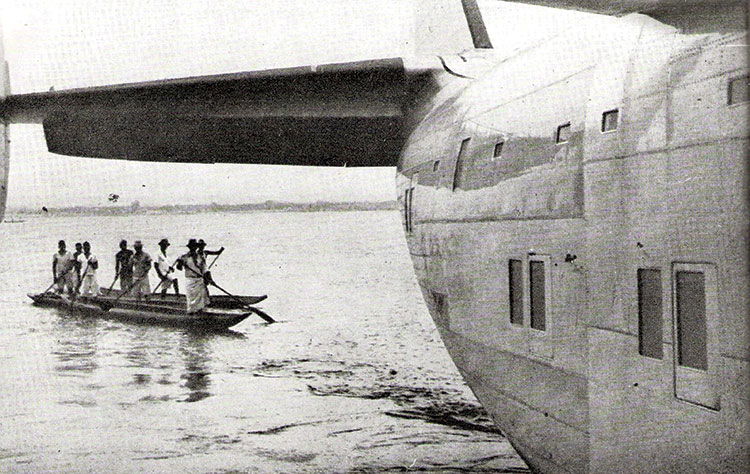
Cadbury had set out on his economic mission in a tiny flying boat, which refuelled first in a harbour of southern Ireland, where the half-dozen passengers were astonished by the ready supply of real butter. A night flight, avoiding the Vichy anti-aircraft batteries in French Africa, brought the craft to the River Gambia at first light on its way to Freetown and Lagos. Refuelling at Libreville was done by hand, pumping drums of petrol into the tanks from a canoe, before the last hop brought them to Stanley Pool, which separated the two Congolese capitals of Free French Brazzaville and Belgian Léopoldville. There, Cadbury met his opposite number, a middle-aged American diplomat called Sam Day. They were not welcomed by the Belgians, who feared any interference in their economic autonomy or threat to their political status.
The hierarchy of obstruction began in the office of the Belgian Prime Minister, Hubert Pierlot, who, Cadbury claimed, came on a visit to Congo from exile in London and caused much bureaucratic disruption. Hostility was reinforced by the Belgian Minister for Colonies, who spent some time in Africa. The most immediate handicap was presented by the Governor-General’s department of economic affairs, which withheld key commercial statistics from the Anglo-American mission for weeks on end. Cadbury, the cautious amateur diplomat, was initially careful in what he said even in the most strictly confidential of memoranda, but once he had crossed the river into French Congo his private letters to his family allowed him to unleash his frustrations. In the territories of French Equatorial Africa the local people were delighted to welcome a visitor and laid on astonishingly elaborate meals, despite the wartime conditions. The exception to this welcome came from a few pro-Vichy settlers, who were dismayed by news that US troops had landed in North Africa and were heading towards Algiers. As a source of strategic war materials, particularly rubber, French Congo and its satellites all the way up to Cameroun were no match for the potential offered by Belgian Congo.
The delicacy of the Cadbury-Day mission was two-fold. First, it had to ensure that enough attractive manufactured goods were available at affordable prices to give an incentive to Africans to go out into the bush and harvest wild rubber. If there was nothing appealing to buy in the shops, then any economically shrewd Congolese would revert to subsistence production rather than market production. At the other end of the scale the standard of living of the expatriate population had to be maintained at a viable level despite wartime hardships in Europe. Although Belgian missionaries had long adapted to a lifestyle based on local African food supplies, Belgian civil servants and commercial agents expected to eat and drink as they had always done, in high colonial style. The economic mission therefore authorised the importation of astonishing quantities of butter and cheese, though it hoped that half this supply might come from South Africa and so not take up North Atlantic shipping space. The mission’s balancing act had to calculate not only how many matchsticks might be needed in Congo, but how to maintain colonial morale and assess the practicalities of distributing food, drink, clothing and all other consumer goods.
Transport was a vital and complex part of this task. At the lowest end came the bicycle, of which 5,000 new lightweight English bikes were deemed necessary to supplement the 50,000 already in service. The sandy tracks and thorny paths were hard on tyres and so, in spite of the loss of Asian rubber supplies, an order for 180,000 bicycle inner tubes was authorised for delivery in 1943. The next item of transport thought essential for efficient mobility on rudimentary rural roads was a small, English, 350cc motorcycle, judged preferable to a heavy American Harley-Davidson. A sidecar for a third passenger, or for freight as was common in Europe, was not deemed suitable for Congo’s twin-rutted trails. The motorbikes also required a plentiful supply of rubber tyres and inner tubes. A motor car, which an expatriate aspired to own in the absence of buses, was only really useful in town, where short stretches of asphalt had been laid. During a road trip along the stony highway west of the city, Cadbury only met four other cars over the course of three days. The life of a vehicle, often driven by an inexperienced chauffeur
who understood little of maintenance, was estimated to be as short as 40,000 miles under Congolese conditions. Cheap replacement vehicles and spare parts for simple cars were essential, but the Cadbury formula banned the import of status cars, much to the dismay of proud Belgians. The local administration was forever trying to maximise its assessment of import requirements, rather than to estimate the minimum of essentials required from overstretched British suppliers. A request for 1,350 new cars was cut back to 400. Cadbury and Day halved or eliminated entirely many other import quantities desired by the Congo economic department.
Lorries played an important role in transport politics. Despite the rudimentary state of the roads, a fleet of 350 lorries was sent all the way up to Abyssinia (Ethiopia) to supply allied troops fighting Mussolini’s occupying Italians. Many of these vehicles broke down along the way, but 250 struggled back to Congo in need of repair parts from America. Another requirement was for lorries equipped with desert-quality tyres, which were expected to trail up through French Equatorial Africa to Lake Chad and then cross the Sahara to supply allied troops in Egypt and later in Libya, since the Mediterranean sea routes were under heavy attack. All these lorries were tiny by postwar standards and anything over three tons would not have safely crossed narrow bridges or rudimentary pontoons. Three-ton trucks were supplemented for local work by one-and-a-half ton pick-up vehicles made by Ford and Chevrolet. An order for 2,000 trucks was approved but it seems to have been assumed that wooden bodies would be built onto imported chassis when they arrived. Keeping all these disparate vehicles on the road was a nightmare requiring at least a dozen sizes of tyre, not to mention 27,000 tons of petrol. The Anglo-American mission cut back the annual petrol allocation from a requested 40,000 tons, though it recognised that additional petrol imports, from a Dutch refinery on the Caribbean island of Aruba, might be needed to cover either French Congo or American military requirements.
Heavy traffic was carried by a railway, which hauled all imports for western Congo up from the ocean port of Matadi across a 3,000ft plateau. A parallel Congo-Ocean railway was also run by the French between Brazzaville and the sea. The train required a supply of good quality coal; coal from Nigeria was unsuitable for Belgian steam engines. Eastern Congo obtained some coal from Southern Rhodesia but sending it to Léopoldville would have involved multiple trans-shipments from rail to barge and back along a river route interrupted by several sets of rapids. During the war the Katanga railways in the east of the country sometimes used wood as fuel, but in western Congo it was believed that the flying sparks from wood-fired engines would be too dangerous with freight that included ammunition. Coal consumption had to be carefully measured by the British chocolate manufacturer and his American colleague. The railway terminus was on the Léopoldville quayside, where tugs with strings of barges took over from the train. The economic assessors had to estimate how much lubricant would be needed to keep the Congo river-traffic flowing with wood-fired steam tugs. When watching the flurry of port activity, Cadbury was fascinated to see that the tugs were captained by expatriate skippers, who travelled up and down the river with their wives and children on board, rather like canal barges.
Travel by rail, road or river was always unreliable in Congo and by the 1940s the country had become partially dependent on small aeroplanes. The Belgian national airline, Sabena, owned four American Lockheeds, seven German Junkers and seven Dutch Fokkers. Cadbury agreed that a request for six twin-engine American Dakotas be approved to increase the fleet. As in the case of lorries, consideration was given to the supply of fuel and especially to stocks of spare parts without which planes might wait grounded for three months at a time. Air travel, however, was precarious. When Cadbury crossed the river to Brazzaville he was able to hitch a ride to Lake Chad, wedged in the rear gun-turret of a Blenheim bomber with a broken window. He did not accept the return flight, on which the pilot and navigator were both killed when their poorly serviced plane crashed. Cadbury hitch-hiked down to the Cameroun coast looking for possible supplies of rubber and admiring the stands of cocoa trees bearing a crop with which he was familiar. He eventually got back to Léopoldville, where he was presented with the document that the department of economic affairs had reluctantly prepared for him. On receiving the list Cadbury radically annotated it with his own recommendations and then, as ‘the fat began to fly’, he posted copies to London and Washington by diplomatic courier and escaped via Katanga and Kenya to his next assignment in Madagascar, a colony which, like French Congo, had sided with Britain rather than with the Vichy régime. His colleague Sam Day was posted to Angola with a view to opening a US consulate in Luanda.
The Belgian Congo had a number of connections with Angola and its Portuguese colonial overlord. One of Cadbury’s excursions had been to the town of Thysville, which had a major sugar plant-ation and a refinery that might have been encouraged to expand production to save on sugar imports. The firm was run by a Flemish family but the estate was worked by black Angolans who crossed into Congo in order to earn cash. This they needed not so much in order to buy clothes, as Congolese wage-earners did, but to pay the poll tax imposed by Portugal on workers and on their wives. Angolans had been regular immigrants to Congo ever since the Belgians had first arrived. Some of these Angolans became integrated into the network of Baptist chapels and schools which straddled the international frontier. Second generation
Angolans often acquired commercial and technical skills which enabled them to remain in Congo as employees of the many Portuguese commercial enterprises in the colony. By the time of Cadbury’s visit 20 per cent of the Léopoldville population were Angolans. Portuguese businesses supplied much of the city with fresh meat and produce, though expatriates often aspired to live off better quality imported foods. The Belgian list of food imports deemed necessary was astonishing to anyone familiar with England during the austerity years and Cadbury pruned it severely before sending it to London under a strictly confidential cover. Alongside tons of butter and cheese the Belgian schedule listed biscuits, chocolate, breakfast cereal, mustard, spice, pears, grapes, jam, marmalade, dried or preserved fruit, dried, condensed and evaporated milk, 20 metric tonnes of Portuguese olive oil, dried onions, pickled vegetables, honey, canned herring, tuna and sardines, bars of European table salt, Ceylon and Kenya tea, dried meat and bacon, black puddings and sausages, quantities of macaroni and tapioca, fresh and tinned yeast, two million litres of table wine and, most important, 200 tons of spirits including gin and Scotch though, it was specified, not Canadian whisky. Around 8,000 tons of dried Angolan fish and 2,000 tons of Cape Verde salt were ordered for consumption by Africans. The salt and the dried fish were essential to the mission’s main aim of driving locals to work for wages and produce raw materials to further the war effort. One surprising aspect of the Cadbury report is how much of the requested food and drink supplies he did authorise rather than how many headings he deleted.
Salt and dried fish had been the backbone of the Congo commercial economy from early in the Iron Age and, 2,000 years later, both items feature prominently in the 1942 commodity list, as do iron and textiles. Congo had long been a great exporter of metals and, since the ninth century, copper ingots from Katanga had been reaching Asia. Congo also exported gold, though it gets no more than a cursory mention in Cadbury’s report. Iron, on the other hand, was an important item. Sam Day, accustomed to American architecture, argued that houses for Europeans should be screened with wire mesh to keep out flying insects (nylon mesh had not yet been invented).
Cadbury, though, argued that mosquito bed-nets of cotton would be adequate and much cheaper. He did admit, however, that Congo mosquitoes were so voracious that they clustered under his dining table and bit him through his thin trousers. Indeed at one low point on his sojourn he went down with malaria, this in spite of dosing himself daily with quinine, a natural prophylactic discovered almost 100 years earlier. The demand for heavy iron, rather than wire mesh, concerned iron girders for commercial buildings. Cadbury argued that the quantities of steel ordered were quite unnecessary and that timber could be used instead. He recommended the importation of steel band-saws to cut heavy timbers which could support roofs that would no longer be made of corrugated iron sheets but of locally-made terracotta tiles. The new buildings would also use local, rather than imported, cement but strong paper sacks to carry cement would have to be supplied from abroad.
The insatiable African demand for iron was primarily for tools and utensils. Iron picks and hoes could, at a pinch, be made by local blacksmiths but steel axes could not. Knives, forks and spoons were also imported rather than locally made. In an age before plastic, when aluminium was new and expensive, the African desire for brightly coloured enamel bowls was enormous. These iron vessels ranged from small domestic plates to huge basins 3ft across on which heavy quantities of oranges, bananas, cassava roots and maize cakes could be head-loaded. For cooking stews and soups, metal ‘missionary’ cauldrons were also in demand to supplement the local supply of pottery tureens. Liquids were traditionally carried in gourds or calabashes, but by 1942 glass bottles were widely in use. Although bottles could be recycled at the local brewery, Cadbury had to authorise the importation of many thousands of metal crown corks. Bottled beer was an alcoholic beverage much favoured by wage-earning Africans.
The textile requirements were the most demanding item for which shipping-space was required. Historically Congo textiles were made, often to high standards, with palm raffia, but by the 19th century cotton cloth, which had long been traded on the coast, began to reach into the heart of the continent. In 1942 1,000 tons of woven cotton textiles were locally manufactured but another 5,000 tons were imported. Maintaining the supply of textiles, Cadbury declared, was the key to driving Africans into the cash economy and so getting them to produce materials needed for the war effort. He seems to have been surprised that appeals to ‘patriotism’, such as the ‘Dig for Victory’ campaign in Britain, had no impact on Africans. There was no such thing as ‘patriotic’ loyalty to the Leopoldian and Belgian régimes. It was only 34 years since the ending of the worst scandals of King Leopold’s murderous reign, when anyone who failed to meet the quota of rubber they were expected to collect might be liable to severe punishment. The Belgian colonial regime that replaced Leopold’s mercenaries was less violently brutal but some work schedules had still been driven by fear of punishment as much as by hope of reward. Thus it was that Cadbury and Day had to ensure that style-conscious Congo Africans would find on the market the brightly coloured cotton prints they desired. It was recognised, however, that cleaned and sterilised second-hand clothing, or sub-standard ‘seconds’ being disposed of by Europe’s textile mills, would also sell reasonably well in Congo. The blue, grey and khaki American textiles were much less popular.
The Anglo-American economic mission realised that, next to the bicycle, the most expensive and desirable item that Africans would save up to buy was a sewing machine. African tailors valued treadle machines and Cadbury authorised 100 treadles as well as 300 hand machines. With an adequate investment, a seamstress could turn imported cloth into a sharp shirt or a fashionable dress. The object of the mission was, as ever, to ‘soak up’ all available cash in African hands so as to get men and women back to producing raw materials once they had met their ‘target’ of buying a prestigious and expensive sewing machine or bicycle. Above all, the mission wanted Congo workers to collect rubber and the market was prepared to pay. The price for rubber from trees was one shilling and twopence per pound but traders were willing to pay almost as much for good quality wild root or vine rubber. Low-grade rubber, which was often adulterated, still fetched seven-and-a-half pence per pound on a market anxious to replace Asian supplies. Cadbury’s efforts helped to increase Congo rubber production and half a ton of rubber could buy a bicycle. The commercial incentives were never sufficient, however, and compulsory labour was also used. Exports never rose to match those of the American plantations in Liberia, let alone the British ones in Ceylon, but over two years Congo rubber exports did increase to more than 10,000 tons a year.
If sewing machines and bicycles were the key enticements to demand in Congo, other items on the consumer list show a fascinating range of hidden needs and potential incentives to drive people into the market-oriented economy. An order for 1,000 wireless sets required all the necessary batteries. A range of haberdashery and garments of linen, silk and cotton required more than 1,000 tons of shipping space, though not the 3,000 tons Belgians had requested. Shoes and boots were ordered to supplement the output of the local Bata factory, but Cadbury noted curiously that military parades were conducted in silence, since soldiers marched barefoot. A huge consignment of cotton blankets from India was not only approved but increased. The local economic department was more concerned with European aspirations than with the African need for cheap blankets. For the African market, ‘tons’ of cheap combs were ordered. One curious item not challenged by Cadbury was for 45 ‘tons’ of toilet paper. Bath soap and shaving soap were approved, despite the availability of local bars of laundry soap. Razor blades were also deemed essential, along with a reduced supply of charcoal-heated laundry irons. Before the war Congo had received annually 20 tons of muzzle-loading guns and the necessary supply of black gunpowder. Guns were used not only to hunt food-game but to enhance ‘native’ wellbeing with loud celebrations. Keeping up morale was part of the mission’s brief and Cadbury, the sober Quaker, authorised the purchase of playing cards from South Africa.
Cadbury left Congo in November 1942 but the expertise he had acquired during his four months in Léopoldville continued to be called upon. In 1943 French Congo submitted to Britain an even longer and more inflated list of consumer demands than the Belgians had done. Although Cadbury’s relations with the Free French on the ground in Brazzaville had been cordial, relations between the exiled Free French government in London and British ministries were anything but. ‘My dear Cadbury’, wrote the British delegate to the French National Committee at St James’s in May 1943, ‘I hope you are not heartily sick of being pursued on the question of supplies for the Free French.’ A British consular report from Brazzaville had complained bitterly of ‘over-ordering’ and ‘wastage’. The focus of war had now moved north towards the Mediterranean and French Congo was no longer of great strategic importance. Although Cadbury radically reduced the hundreds of items the Free French requested he did think that an ice-plant should be shipped up to Chad. When, however, it was noted that cement had been requested, to build a new museum in Brazzaville in the middle of a world war, outrage once more exploded. After Cadbury left tropical Africa, his role as a stern assessor of consumption needs continued into 1944, when he was posted to Algeria to assess the requirements of the indigenous population, as well as those of the white settlers. At the time the minister responsible for Algeria was Harold Macmillan, the future prime minister who began the decolonialisation of the British Empire in Africa and thus paved the way, in 1960, for the decolonisation of both French Congo and Belgian Congo.
David Birmingham is Emeritus Professor of Modern History at the University of Kent. His Short History of Modern Angola was published in November 2015.