The debates around the Windrush scandal of 2018, which saw people wrongly deported by the UK Home Office, reactivated discussions of Britishness, race and belonging. They also triggered references to history, from the traffic of enslaved Africans to Caribbean plantations, giving credence to Michel-Rolph Trouillot’s assertion that ‘the past is only past because there is a present’. But, for all this, the historical retrospective went back to the Empire Windrush’s landing in 1948, but then made a chronological jump to the days of enslavement. This all but silences 110 years of British colonial history, from 1838 to 1948, a period when ‘loyalty to king and empire’ and ‘the glory, protection and civilisation that the British Empire bestowed’ became central to the colonial project. But also during that period, about a third of a million British subjects became part of an intra-Caribbean diaspora in the Americas, in places such as Panama, Costa Rica, Guatemala, Honduras, the Dominican Republic and Cuba. There, they worked in (mostly) US-driven infrastructure projects and agro-industrial export enterprises.
Register to read more articles for free.
When you register, you will receive the History Today newsletter. Click here to read our Terms of Use.
The debates around the Windrush scandal of 2018, which saw people wrongly deported by the UK Home Office, reactivated discussions of Britishness, race and belonging. They also triggered references to history, from the traffic of enslaved Africans to Caribbean plantations, giving credence to Michel-Rolph Trouillot’s assertion that ‘the past is only past because there is a present’. But, for all this, the historical retrospective went back to the Empire Windrush’s landing in 1948, but then made a chronological jump to the days of enslavement. This all but silences 110 years of British colonial history, from 1838 to 1948, a period when ‘loyalty to king and empire’ and ‘the glory, protection and civilisation that the British Empire bestowed’ became central to the colonial project. But also during that period, about a third of a million British subjects became part of an intra-Caribbean diaspora in the Americas, in places such as Panama, Costa Rica, Guatemala, Honduras, the Dominican Republic and Cuba. There, they worked in (mostly) US-driven infrastructure projects and agro-industrial export enterprises. Therein lies the immediate pre-history of the Windrush generation, in experiences that illustrate an older, contentious history between blackness and Britishness, outside the imperial domain.
British in the Caribbean
During the late 19th and early 20th centuries, black British Caribbean migrants in Hispanic territories made assertive demands for British support and requested services from Foreign Office personnel. But, the historian Glenn Chambers concludes: ‘Despite the propensity for West Indians to claim British citizenship in Honduras, the British Empire did not take the needs of its black citizenry abroad seriously.’ Indeed, the sociologist Moji Anderson, in her study of the 1918-19 banana workers’ strike on the United Fruit Company lands straddling Costa Rica and Panama, shows that ‘racist attitudes of consular officials did play a part in prejudicing the evaluation of the strike’, even as these officials acted on their obligations to British subjects.
The criticism of Foreign Office personnel for not paying full attention to the claims of Caribbean British subjects was also true of the Dominican Republic. In the northern coastal town of Puerto Plata in 1930, migrant workers accused the vice consul of failing to protect them against ‘inhuman treatment inflicted on British subjects’ that was ‘degrading to our nationality’. A letter to the British consul in the capital, co-signed by 93 members of the ‘British Defense Society’, argued that the vice consul’s ‘disinterested attitude’ was ‘due to the fact of his not being born and bred a Britisher – and thus his vague opinion as to the principles of equality and mutual respect, upon which the great British Empire is founded’. As people ‘of British birth and ideals’, they therefore requested that a new vice consul be appointed.
British consuls were also criticised in Cuba, where more than 140,000 British Antilleans went as migrants between 1898 and 1948. Consuls were part of diplomatic disputes with the Cuban government regarding abuses against British subjects in Cuba, as exemplified in the aftermath of the 1917 massacre in Jobabo and the white papers about ill-treatment on the island published in 1924. But this diplomatic representation was tainted by racial differences within the British Empire, not unlike those that would later become evident in the UK after 1948 (and, certainly, in 2018). In a statement that displays the treatment received by British subjects based on race, for example, the Barbadian Joseph Hall wrote from prison claiming to British authorities that no representative ‘came to see if I was white or black’. The accusation, however, was deemed ‘inexact’ by the consuls and no further explanation was given. The racial distinctions around British subjecthood were evident in a report on the Cienfuegos vice consulate in the 1920s by Inspector T.D. Dunlop, in which he stated: ‘Besides the 12 white British subjects in Cienfuegos, there is a floating population of about 100 coloured Jamaicans.’
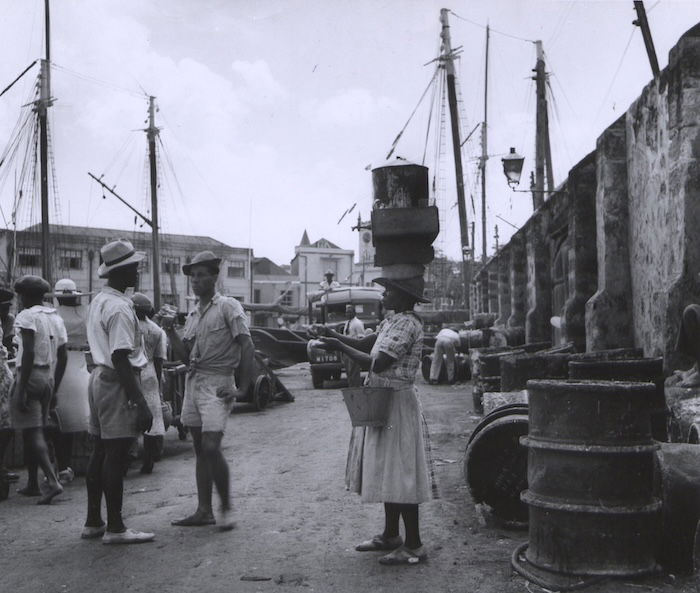
Habour workers in Bridgetown, Barbados take a break, 1950. National Archives. Public Domain.
In Central America, a report from the British Legation in Guatemala indicated that some of the migrants ‘are naturally bad characters’, who ‘arrive with an exaggerated sense of their importance as British Subjects’; it acknowledged their ‘legal rights as is afforded by the happier conditions of British rule’, while also referring to them as ‘negroes’. The same racial descriptor was used by vice consul Archibald Beer in the Dominican Republic when he reported on ‘various deputations from negroes’ he had received discussing the immigration tax imposed on them in the 1930s. He proceeded to refer to them as ‘British subjects (alleged)’ and raised doubts about their statements. Accordingly, in Cuba in the 1930s, Neil Hone, who considered himself one of the ‘few British’ in north-east Cuba, wrote to the Colonial Office about ‘destitute men, claiming to be British Subjects’. Clearly, (white) racial understandings about Britishness were being rehearsed in an encounter between British officialdom and black British subjects outside of the imperial domain and before 1948. Migrants had to contend with double discrimination, in the Hispanic host societies and through the disavowal of British officials.
Disposable workers
As economic depression and nativist policies combined in the Hispanic Caribbean during the 1930s, thousands of British Caribbean migrant workers became disposable. They met increased hostility in Cuba and the Dominican Republic, where policies such as concerted mass deportations, special taxes and compulsory identification cards were implemented. But British Caribbean colonies were experiencing their own troubles in the late 1930s. Thus colonial administrators looked for ways to avoid the migrants returning to their home islands and operated as labour managers trying to move them to where they would not disturb the already fragile social conditions in suffering colonies.
The condition of British subjects in foreign territories was surveyed by Frank Stockdale in 1943. In Cuba, British Caribbean migrants gathered to meet him and that same year they established associations that indicated their British allegiance, including branches of the British West Indian Progressive Association. In Chaparra, north-east Cuba, the majority of those Stockdale interviewed wanted ‘to return to their island homes’, but were open ‘to go[ing] to any other part of the British Empire’. Similarly, British Antilleans experienced ‘despair and abandonment’ in the Dominican Republic. A report to the Foreign Office indicated that many wanted ‘to leave the Republic for a country under the British flag or to return to their own island home’.
In negotiations with both the Cuban and Dominican governments, the British used their position as consumers of Caribbean sugar as leverage in their negotiations over colonial labour: it was clear that the fate of Caribbean workers was tied to British economic interests and not to their wishes and welfare. In fact, in 1948, a Foreign Office report by M.E. Vibert addressed the relief policies recommended by Stockdale for destitute migrants in the Hispanic Caribbean. It reaffirmed the official disregard for British Antilleans, some of whom had served in the British army during the World Wars or had laboured to produce the sugar Britain needed during these conflicts. Vibert argued that it was ‘almost impossible to get coloured people amongst themselves to do anything for mutual aid’. Moreover, he wrote that there should be no concern ‘about losing these people as British subjects’ because ‘their loyalty to us is mainly sentimental’ and also ‘offensive to the people of the country whom they despise’. In the end, the allegiance of Caribbean British subjects was trivialised and denied from the position of political power.
It is ironic that Vibert’s judgement was made in the year that hundreds of Jamaicans travelled on the Empire Windrush. To use the rhetoric of 2018, disavowed British Antilleans were ‘fighting to be British’ and became ‘citizens of nowhere’, wanted neither where they had migrated nor where they had left.
Black British subjects, struggling to make a living in the post-emancipation era, had left the colonies searching for opportunity. They faced extreme labour conditions building the Panama Canal for the French and the US, encountered death at the hands of Latin American soldiers in the Masica incident in Honduras and the Jobabo massacre in Cuba, and racist harassment by US marines in the Dominican Republic. Hostility also came from British officials, who repeatedly disregarded their complaints, particularly after Stockdale’s report, when the official British strategy was to keep the migrants away from their islands of origin, while encouraging assimilation in the countries to which they had migrated.
This story is part of the remarkable journey of generations of people from the African diaspora, who were determined to succeed and thrive in spite of the challenges of living under British colonialism, escaping from it to foreign lands with different languages and ending by becoming part of the postwar black British diaspora in the UK. Traces of this appear in literary works from George Lamming’s In the Castle of My Skin (1953) to Caryl Phillips’ The Final Passage (1985) and Andrea Levy’s Fruit of the Lemon (1999). As these works indicate, this history is not hidden and the Windrush documents have not been ‘secret’ for a long time. It is because of what Trouillot labelled ‘the moment of retrospective significance’ that historical silence has been broken.
One participant in a discussion on Channel Four News in 2018 hit the nail on the head when she responded to the journalist David Goodhart’s assertion of ‘lack of historical memory’ in the Home Office. She stated that such an idea is ‘in itself a choice’. ‘We choose not to educate the masses’, she said, ‘about the historical links between ourselves and the Commonwealth’, which will ‘foster ignorance about why we are in this place at the moment’. It has been reported that the Home Office review on the Windrush scandal would stress the need of education ‘on Britain’s own history, including its colonial past’. That is a different choice and, indeed, a challenge.
Jorge L. Giovannetti-Torres is author of Black British Migrants in Cuba: Race, Labor, and Empire in the Twentieth-Century Caribbean, 1898-1948 (Cambridge, 2018).