

Alexander Hamilton, Founding Father
Gifted, energetic, passionate, unruly, Hamilton was perhaps the most creative figure thrown up by the American Revolution, argues Esmond Wright.
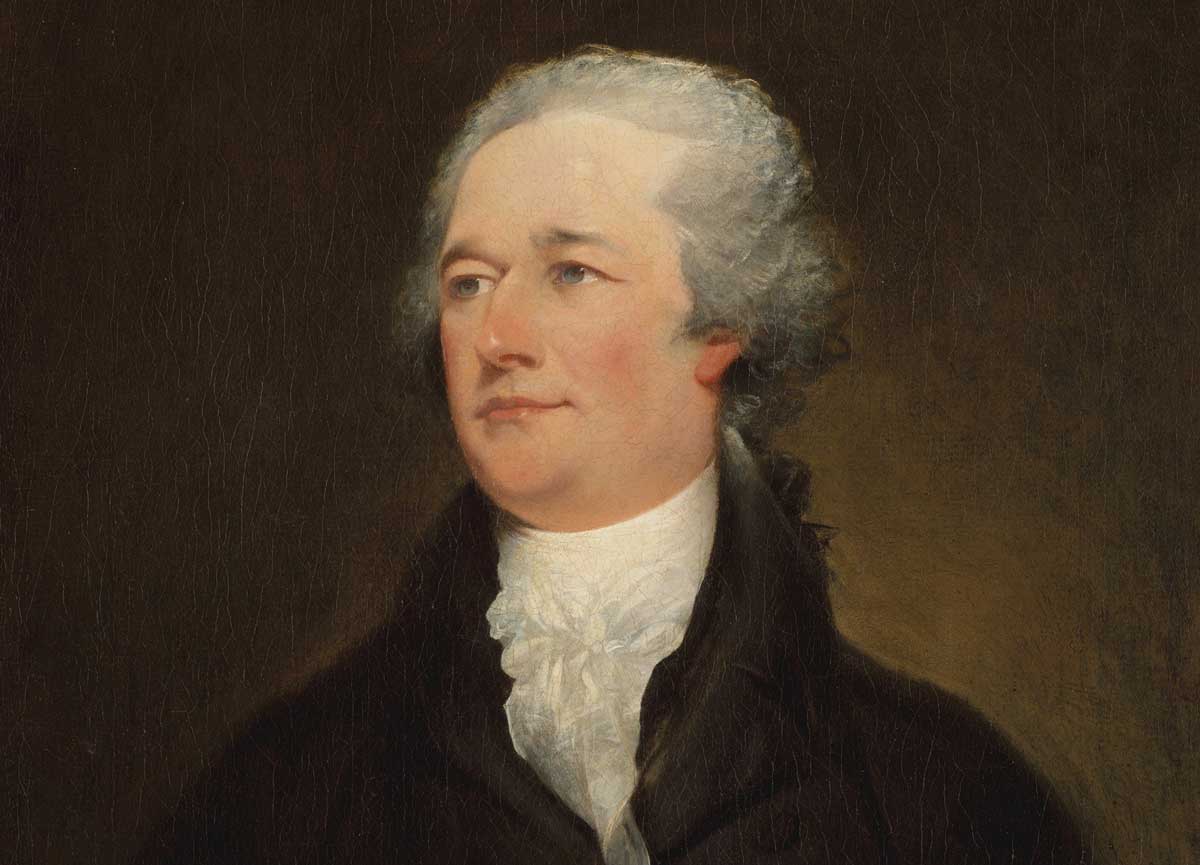
The decade from 1790 to 1800 in American history remains largely terra incognita. While other periods, especially the Revolution and the Civil War, have been chronicled abundantly, the first years of the Republic remain clouded and its citizens shadowy beings – unless, in their own lifetimes, they were seen to be ‘demi-gods’.
Franklin was so seen, to his amusement; Washington, to his embarrassment. But this process of ‘amplification,’ largely the work of Weems and Marshall, Gilbert Stuart and the Peales, was highly selective.
The mythology and hero-worship inseparable from nation-building are of course largely fortuitous. Soldiers are preferred to ‘organisers of victory,’ adventurers to politicians and financiers; simple men of action make better symbols than the complex and the paradoxical. Yet, in any reckoning the indifference shown by American historians to Alexander Hamilton, and to the drama of his career, is astonishing.
A man of effervescent charm, short in stature, but fair and ‘uncommonly handsome’; a West Indian immigrant working his way through college, who made the Revolutionary cause his own; for more than four years ‘first aid’ to the Commander-in-Chief, as the Spanish envoy happily described him, and a fighting soldier with Lafayette at Yorktown; joint author with Madison of the Constitution and of The Federalist, the 85 essays which, more perhaps than anything else, secured the adoption of the Constitution in New York; ‘prime minister’ to the first President; Secretary of the Treasury, whose report on credit and whose banking policies established the solvency and set the course of the new state; major contributor to Washington’s Farewell Address and thus to the shaping of American foreign policy for the next century; a meteor that swept across the political scene and whose brilliance was so dramatically extinguished: why has Hamilton’s personality left so little mark?
Was it that his point of view, often so arrogantly voiced, was distasteful and even alien? – ‘your people, Sir, is a great beast’. Was his confidence in himself, so well-justified, nevertheless too extravagant, his capacity for work too overpowering, his long and masterly essays, written almost without pause or need of correction, too persuasive for the man himself to be accepted, much less loved? Was his integrity itself too lofty and too conspicuous, his devotion to the new nation a shade exotic? Or did he merely die too early, cut off before he was 50 by Aaron Burr’s pistol shot? Yet his work was done four or even eight years before.
And the end was surely in itself material for legend – his life sacrificed in part for the sake of the Union, his devoted wife and large family destitute, his murderer a hunted fugitive with his schemes for secession largely destroyed. His death proved good business for John Trumbull, who was kept profitably employed for years turning out replicas of his Hamilton portraits. Yet the legend never came to birth, hard though his family tried to induce it.
The success of Hamilton’s work deepens the mystery of the failure of his reputation. He fought for, and secured, the funding of the national debt, irrespective of the question of its ownership, at a time when the great majority of Congressmen expected it to be scaled down. This led to a split between Hamilton and Madison, and fostered the growth of parties; but it tied the rich and adventurous to the new state. He secured also the assumption by the Federal Government of the debts of the states; and this step, even more bitterly fought over, enabled the Federal Government to dominate the revenue sources of the country and greatly consolidated national authority.
He established a bank in which the government owned stock; and, when Jefferson objected that the Constitution did not permit this, he answered with the famous doctrine of implied powers – that the power to charter private corporations or a bank was a natural outcome of the power to coin money, raise taxes and incur debts.
He provided a national revenue by imposing indirect taxes on imported goods and an excise tax on home-produced liquor – two measures of profound significance; for the first demanded a high volume of imports from Britain and so linked the United States with her economically and diplomatically, and the second produced the Whisky Rebellion of the Pennsylvania farmers in 1794. Hamilton’s vehement suppression of this was designed as a display of national strength.
These measures can be criticised, for they divided the country sectionally and politically. But few American historians have criticised the programme of 1791-94: it has been for the most part praised as inspired and percipient; as giving prestige to American currency; as assuring national stability and the supremacy of the propertied classes; as making for close relations with Britain and as providing a base for the steady expansion of the role of the Federal Government. It has been assessed less on financial than on political grounds, as Hamilton intended it should. For his intentions were primarily political, even imperial.
A fully negotiable funded debt, drained originally from the small-property classes and met by taxes paid by the masses, was to be used by an emerging moneyed class to create profitable speculative enterprises in lands, industry and finance.
At a time when few dared to tackle the economic problems of a bankrupt and agrarian society, a clear direction was given to the new nation and an ‘energy to government’, in Hamilton’s own phrase, as well as ‘Order to the finances’. And they were imposed from above. Hamilton, in 1791 as in 1787, advocated republicanism but not democracy.
All communities divide themselves into the few and the many. The first are rich and well-born, the other the mass of the people. The voice of the people has been said to be the voice of God; and however generally this maxim has been quoted and believed, it is not true in fact. The people are turbulent and changing; they seldom judge or determine right.
The sentiments, like the financial policy, proved peculiarly useful to 19th-century America. They seemed prophetic when Carnegie and Rockefeller appeared; and Lincoln’s Republicanism was soon subverted into Hamiltonianism, although then, as now, the imagery was of Illinois rather than New York; the log-cabin is still preferred to ‘The Grange,’ homespun, even coon-skin, to Hamilton’s white waistcoat and black silk small clothes.
Although the language was of laisser-faire, enterprise was abetted by high tariffs and railway subsidies. The 14th Amendment abolishing slavery was twisted into a defence not of African Americans but of big business. Grover Cleveland, the only Democrat in the White House from 1860 to 1912, appealed to businessmen to participate actively in politics. The young Virginian Democrat, Woodrow Wilson, proclaimed in 1889: ‘Ever since I have had independent judgements of my own I have been a Federalist.’ This was the America with which Joseph Chamberlain had sympathy; F. S. Oliver’s essay of 1906, the only English biography of Hamilton, sought in High Federalism the solution to Britain’s own Imperial problems.
It is true that Beard, Bryan, Populists and muck-rakers voiced other opinions; but not all Beard’s research could impugn Hamilton’s own motives and integrity, or deny his achievement as architect of Federalism. In the boom-years of the 1920s, Hamilton’s name, coupled with Andrew Mellon’s, was on everyone’s lips. In the gloom of the 1930s Hamilton’s stock was still high, when Mellon’s was not, as the assessments of Tugwell and Dorfman reveal.
In 1934, when Hamilton’s Papers on Public Credit, Commerce and Finance were re-published by the Columbia University Press, they were described by Elihu Root in his foreword as ‘the lucid and powerful expositions of controlling principle ... the guide by which our nation has become great and respected ... as applicable now as they were then.’
In 1947 as radical a critic as Louis Hacker declared that Hamilton’s reading of his times and of the future of America ‘was that of the wise statesman’. His work as financier and as constitutional draughtsman has received all-but-unanimous praise. But there is still no Hamilton legend. Why?
Behind the rounded and remarkable doctrines was a figure almost as paradoxical as Jefferson himself. For the first of the Federalists and the founder of the nation was born a West Indian; the advocate of aristocracy was born not only in poverty abroad but in shame. As a result, he said little about his origins.
Old John Adams bluntly called him ‘the bastard son of a Scots peddler’; denigrators of Washington have calculated whether the itinerary of his visit to Barbados with his half-brother Lawrence in 1752 allowed for a diversion to Nevis and have suggested a very straightforward explanation of his fondness in later years for the West Indian adventurer. The facts are clear enough – though they have become so only in recent years – and need no embroidery.
Hamilton was born on 11 January 1755, on the island of Nevis. He was always – perhaps deliberately – vague about the year, and 1757 has long been thought the year of his birth, since he described himself in 1773 as ‘about sixteen’. He was the second son of Rachael Faucitt and James Hamilton. His mother, strikingly beautiful and rumoured to be of mixed race, but in fact of French Huguenot stock, had been married, at the age of 16, to a certain John Michael Lavien, a middle-aged merchant of the Danish island of St Croix.
There was a son of this marriage; but it was an unhappy affair. The husband won a divorce that, by the stringent law of the time, prevented the wife’s re-marriage, and she returned to her native Nevis. There she met James Hamilton, a younger son of an Ayrshire family; he was gentle, scholarly and unsuccessful; yet he gave to his younger son a family pride that offset the poverty and ignominy of his boyhood. His home in New York was to be named after the family house, ‘The Grange,’ in Ayrshire.
The young Hamilton was brought up in Christiansted on St Croix – where his father abandoned his mother, and where, when Alexander was 13, his mother died. He worked in Nicholas Cruger’s store and showed great talent at business. He never received much affection and grew up gifted, ambitious and self-contained. He sought success and power in a bigger world, as he wrote in his first extant letter to his friend, Ned Stevens, then at King’s College in New York (November 1769):
To confess my weakness, Ned, my ambition is prevalent, so that I contemn the grovelling condition of a clerk or the like, to which my fortune condemns me, and would willingly risk my life, though not my character to exalt my station ... I wish there was a war.’
The opportunity came in violent form, more devastating than a war, in the hurricane of August 1772. Hamilton’s account of this came to the notice of Hugh Knox, Presbyterian clergyman in the islands, and was published by him in the Royal Danish-American Gazette.
Knox persuaded the boy to go to Princeton, and provided him with letters of introduction to William Livingston and Elias Boudinot in New Jersey, who became his first – and not his last – mentors; for Hamilton’s career shows, interalia, how far it is possible for a protégé to travel. He appears to have arrived in New Jersey not in 1772, as so many of his biographers hold, but a year later.
According to Hercules Mulligan, he first tried to enter Princeton but made impossible demands on the small staff. At least a year before the Revolution began, Hamilton was a student at King’s College, N.Y., absorbing High Toryism from Dr Myles Cooper, but also absorbing – and voicing – revolutionary sentiments in the student clubs and debating societies. The war he sought came and, with it, an enthusiasm for his new country and a determination to shine in her service.
The war provided opportunity; the pamphleteer became a captain in the New York Artillery and, perhaps on Boudinot’s or Nathanael Greene’s recommendation, a military secretary to Washington in March 1777. From that point Washington’s letters increased in number, in length – and in literary quality.
But, like many another clerk in wartime, Hamilton had dreams of military prowess and, with an eye on a political career, perhaps thought them imperative. Passed over in 1781 for the post of Adjutant-General, he quarrelled with Washington and resigned as aide. In July he got his field appointment and saw action at the redoubts at Yorktown.
In December 1780, Hamilton had put the war to that other traditional use of an aide-de-camp; he married General Philip Schuyler’s daughter, Elizabeth, and merged his fortunes with those of the rich patronage of the Hudson Valley. He was thought to be 23 – he was, in fact, 25 – and he had arrived. Already he had drawn up memoranda for Robert Morris on the establishment of a National Bank.
After Yorktown he practised as a lawyer, was receiver of continental taxes for New York and represented New York at the Annapolis and Philadelphia conventions. He was appointed Secretary of the Treasury in September 1789, and served until January 1795. The years after Washington’s retirement were years of disappointment, of partisanship and of anticlimax.
The first obstacle, then, to the growth of a reputation was that Hamilton rose from nothing and rose fast. Looking, and believed to be, younger than he was, he was thought of, and described, as precocious and brilliant; his talents were regarded as mercurial, and the extraordinary capacity he showed for sustained work during the war was appreciated by few except Washington. Surrounded by older men, and flattered by them, his vanity grew.
Yet, although no one doubted his patriotism, he was considered an outsider in wartime and was naturally passed over for posts of real responsibility. Adams thought of him in this way to the end, and in 1809 excused his errors on the grounds that he was ‘not a native of America,’ and that ‘he never acquired the feelings and principles of the American people’.
Hamilton recognised this himself : ‘Every day proves to me more and more that this American world was not made for me.’ Moreover, he was backed by men of substance: Boudinot, Schuyler and Washington. He saw himself as a natural aristo and became the advocate and apologist of the Right, a Burke to the great Oaks of the Revolution, but with a skill in finance to match his skill in words.
Yet like Burke he was never quite accepted, isolated by his abilities, by his foreignness and by his arrogance. If in one way he was proof of the accuracy of Dr Johnson’s remark that anything can be done with a Scotchman ‘if he be caught young’, he disproved the great panjandrum’s other maxim: ‘Slow rises worth by poverty depressed.’ In the New World careers were open to talent; but even there a man could be too obviously on the make.
The doubts about the man’s background and stability were reinforced by his declared beliefs. For Hamilton has earned misdirected and unmerited approval as a designer of the Constitution. He accepted it and worked for it, but only as a second best; and his doubts about its durability continued until the day he died.
He described it in 1802 as ‘a frail and worthless fabric which I have been endeavouring to prop up.’ What he admired was discipline and authority in government; what he preached was mercantilism. He subsidised those who invested in manufactures and public securities; he taxed the landed interest.
He favoured an ‘hereditary’ chief magistrate, representing the ‘permanent will’ of society and capable of curbing the ‘turbulent and uncontrolling disposition’ of democracy. He wanted an upper house chosen for life on a property basis. ‘Our real disease,’ he wrote on the night before he was shot, ‘is democracy.’ As a result, a leading student of American conservatism refuses to describe Hamilton as a conservative at all, but as a Federalist who advocated ‘Rightism run riot’.
If he was conservative in practical politics and in his concern for property, he was reactionary in his devotion to monarchy and hereditary aristocracy, visionary in his scheme for an industrial America, and who-knows-what – radical, reactionary, or just plain opportunistic? – in his eagerness to reduce the states to an inferior position.
His basic ideas, which he voiced on the floor of the Convention, were irrelevant in the American environment and were certainly not those of a man who knew and cherished the American tradition ... No man could be so indifferent to the established order, full of schemes for its alteration, dazzled by plutocracy, and casual about centralized power and still lay claim to the title of conservative.
This formidable indictment reflects Hamilton’s past. His economic-cum-political views were shaped in fact less by America than by his youth in the store in the lush sugar islands, where prosperity depended – hurricanes permitting – on an elaborate trading system, and where society was hierarchical.
He had no sympathy with Jefferson’s farmer-democrats, but at least the rich, the well-born and the able were given every encouragement, and the fluidity of a free society allowed them to be creative, not destructive.
But in the last analysis it was neither Hamilton’s background nor his ideas that lost him sympathy. No society has been more sympathetic than the American to the immigrant and the man on the make, as the Revolutionary catalogue and later years attest. Ideas about the Constitution varied widely; Paine and Jefferson and George Mason had their own doubts about it, of a different kind from Hamilton’s.
Hamilton’s failure was a failure of personality; the creed was bigger than the man. Although his financial doctrines were wise, he could be as inconsistent as Jefferson himself. In The Federalist (Nos. 12 and 21) he declared that ‘the genius of the people’ hated excises; but they were an essential part of his revenue system in 1791; and in 1794 he was employing force to crush the resistance to them of the Whisky Rebels in Pennsylvania.
The advocate of isolation in The Federalist No. 11 became in 1794 the notorious Anglophile of the Jay Treaty; the supporter of free elections and free choice in 1787 later tried to nullify the popular vote and threatened force in the process. He claimed in 1787, and in 1791-4, to ‘think continentally’; yet by 1800 he was the not-fully-avowed leader of the High Federalists, at odds with President Adams and wrecking both Adams’ administration and his own party.
Increasingly he advocated the use of armies: in 1794 to crush Pennsylvanian farmers; in 1798, when he became Inspector-General, to go to war with France – or perhaps to embark on a great crusade as Libertador in Spanish America; in 1800 to preserve Federalist power in New York.
‘In times like these,’ he told John Jay, ‘it will not do to be over-scrupulous.’ He split with Adams because the President kept peace with France. He thought Jefferson ought to go to war to gain Louisiana; but, when Jefferson achieved its purchase in a staggering diplomatic triumph, Hamilton wrote:
The advantage of the acquisition appears too distant and remote to strike the mind of a sober politician with much force ... It... must hasten the dismemberment of a large portion of our country, or a dissolution of the Government.
The passionate nationalist could become the most bitter and irrational of partisans.
To these contradictions he added a capacity for quarrelling with almost every one of his closest associates. The high integrity and devotion to his country were outmatched by a devotion to his own career that involved him in endless intrigues. He quarrelled with Washington in 1781, when his Commander-in-Chief charged him with tardiness and disrespect.
I replied, without petulancy, but with decision; ‘I am not conscious of it, sir, but since you have thought it necessary to tell me so, we part.’ He explained to his father-in-law that he ‘always disliked the office of an aide-de-camp as having in it a kind of personal dependence’.
Washington, he said, was ‘neither remarkable for delicacy nor good temper’. Yet Washington sought to apologise within the hour, to be sharply rebuffed, and he continued, in 1781, as in 1789, to harbour no grudge. Though both men were under strain – it was eight months before Yorktown – the fact remains that the older man emerges with the greater honour.
Washington was fully aware of Hamilton’s ambition, but appreciated his talents. Adams was less kind and, like his party, suffered acutely at his hands after 1796. His Cabinet was staffed with Hamilton’s men; and for four years Hamilton was ‘the worm at the root of the peach’, ‘the Creole adventurer,’ ‘the Creole bastard.’ Adams’ son, John Quincy, thought Hamilton’s ambition:
transcendent, and his disposition to intrigue irrepressible ... he was of that class of characters which cannot bear a rival – haughty, overpowering, jealous, bitter and violent in his personal enmities, and little scrupulous of the means he used against those who stood in the way of his ambition.
If the Adamses cannot be thought impartial, Noah Webster, a staunch Federalist, equally deplored Hamilton’s wrecking of the party. In his Open Letter to General Hamilton, in 1800, he said ‘your ambition, pride and overbearing temper have destined you to be the evil genius of this country’. Abigail Adams saw the trend even more sharply. ‘That man’, she said, ‘would become a second Bonaparty if he was possessed of equal power!’ The charge was valid; Hamilton’s hero was Julius Caesar.
The years after 1800 were years of failure. Although devoted to his wife, he was not faithful, and was ready to reveal his liaison with Maria Reynolds rather than allow the blackmailing activities of her husband to be thought attributable to any political immorality. With the Republican victory in 1800, largely due to his own quarrel with Adams, his power had gone. By ensuring Jefferson’s election as President he made a mortal enemy of Aaron Burr, who had tied with Jefferson in the Electoral College.
In 1801 Philip, Hamilton’s oldest son, was shot in a duel and his daughter, Angelica, became permanently insane with grief; his wife was pregnant with her eighth child at the time. He emerged from his private life in 1804 to oppose Burr’s bid for the Governorship of New York, which carried with it the danger of a secession of New York and New England from the Union.
The charges ran high; and for some of them, of which he heard at second hand, Burr demanded satisfaction. Trumbull always argued that Hamilton need not have fought and it is not clear from his letters to Burr that Hamilton meant to accept his challenge.
He seems in these last years to have been changing and to have been facing religious and ethical problems for the first time. He recognised that some of his criticisms of Burr had been ‘extremely severe’, and that, according to the code of honour, he owed Burr the right to shoot at him at 12 paces. He made his plans quietly.
On Tuesday night, 10 July 1804, as one account has it – even here there are variants – he arranged for his 12-year-old son, John Church, to sleep with him. The son never forgot how he and his father recited the Lord’s Prayer in unison. Before dawn on Wednesday he rose without waking the boy, rode the eight miles from ‘The Grange’ to New York City and was rowed across the Hudson to the New Jersey Heights of Weehawken.
It was shortly after seven when the two duellists stood to their stations in the wooded clearing high above the river. At the word ‘Present’ two reports rang out, one shortly behind the other; and the shorter of the antagonists, rising convulsively on tiptoe, staggered a little to the left and fell headlong upon his face. As the surgeon hastily examined the gaping hole in his right side, the wounded man had just strength to gasp before fainting, ‘This is a mortal wound, Doctor ...’
And fast as a spreading bush fire, the news went through New York City that Colonel Burr had shot General Hamilton in a duel – that Hamilton was dying – was already lying dead in Mr. Bayard’s house at Greenwich.
The bullet had pierced his liver and lodged in his spine. He lingered on in great pain and died the following afternoon.
Hamilton was a man of great gifts, great achievements and transcendent integrity, perhaps the most creative figure thrown up by the American Revolution. Like some other eminent conservative leaders, he was a social climber, and he cultivated men with power. He had no sympathy for the West, or for notions of local self-government, or for the rights of the States.
Although his view of the Union was synoptic, it hardly included its citizens; administration was more important than the ends it served. Like his hero, Caesar, he was obsessed by the love of fame: ‘the ruling passion of the noblest minds,’ he called it himself. As Adams noted, he was too fond of crises and too ready to use armies to be a good democrat; and he did not hide his scorn for ‘the people.’
For a democracy his very talents could carry their own danger; love of power and lack of compassion could be as serious a menace to the republican experiment as conspiracy within and without. The death of Hamilton at the hands of Burr ended a double threat to the future of the state.
Esmond Wright was Professor of American History and Conservative MP for Glasgow Pollok.

