
Wren Reconstructed
Leo Hollis visits the History Today archive to find an appreciation of Christopher Wren, written by a kindred spirit at a time when both sides of Wren’s genius – the scientist and the artist – were rarely explored.
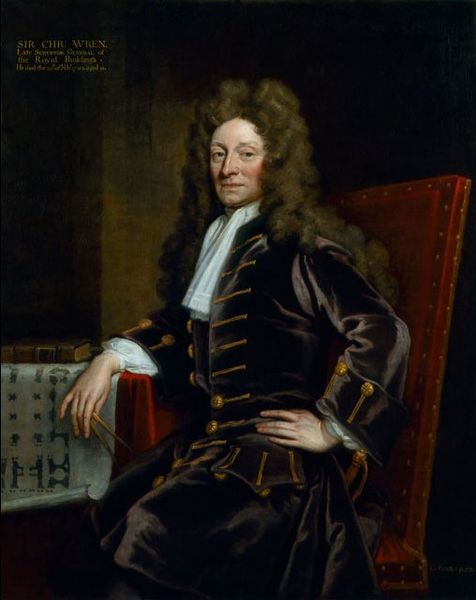
Days after the last embers of the Great Fire of 1666 had died, Wren, the Savilian Professor of Astronomy at Oxford University, produced a new model for London that recast the old city in shimmering modernity. Hutchison had himself re-imagined the city when, as publicity officer for London Transport, he worked on reviving the public transport system after the Second World War. He therefore approached Wren as an admiring amateur, a Londoner in love with the capital’s most glorious architect who had revived the city out of the ashes of the fire. Hutchison saw similar opportunities in the debris of the Blitz. But, as he later noted, by 1973 postwar rebuilding produced not monuments but the ‘undecorated boredom of modern vertical features in ferro-concrete’. As a result he wrote to celebrate Wren, not to judge him.
Wren’s reputation has waxed and waned in the 280 or so years since his death. Once called ‘a miracle of a youth’, he was facing the barbed criticism of the rabidly orthodox Neoclassicists even as the final stones of St Paul’s were laid in 1708. He received a mixed commentary from the Georgians. There was a short burst of praise at the beginning of the 19th century before the Victorians decided that only the Gothic deserved their attention and the queen was heard to whisper that his cathedral was desperately gloomy.
It was only with the eclipse of John Ruskin and the revived interest in Classical forms that Wren found his place in the sun again. At the beginning of the 1920s the Wren Society began its publication of 20 volumes of all things Wren. Following that, there were four biographies in the 1930s, six in the ‘50s, six in the ‘70s and at least another seven since 1998.
Despite this, there have been no unearthed archives to alter the facts of Wren’s life. What is revealed in Hutchison’s article differs little from the latest biography. There has, however, been a major shift of emphasis at the heart of any study of the man.
Wren was born into privilege, the son of a leading Anglican family which endured the privations of the Civil Wars. During this period, he established himself as one of the country’s leading New Philosophers, exploring the frontiers of scientific thinking. As a child prodigy he turned his hand to all forms of experimentation, instrument making and, in particular, stargazing.
It seems peculiar to modern eyes that, within years of the Restoration, Wren turned his attention to architecture and it has become something of a holy grail among biographers to explain this mysterious transition. For the majority, it is Wren’s architecture that is the key to the man and most architectural biographers have glided over the facts of his early life.
More recently, work has been done on Wren’s role as a central character in the birth of modern science in Britain and in the establishment of the Royal Society. This has also explored Wren’s lifelong fascination with experimental science and, in particular, shows how architecture was embedded in his interests from the start. As Hutchison points out, the young student was already devising experiments on ‘new designs tending to strength, convenience and beauty in building’.
In the absence of any new documents explaining Wren’s inner thoughts, we are left to speculate. His legacy is all around us yet we must be careful how we look at his buildings. Today one is more likely to encounter Wren within the art history department of a university than in the mathematics faculty. Wren would not have understood the separation; he was as likely to discuss with his friends the properties of gravity as the shape of the Mausoleum at Halicarnassus.
What this highlights is a more malign influence over historical studies. In May 1959 the novelist and physicist C.P. Snow gloomily observed that society was divided by two cultures, the scientific and the artistic, and never the twain shall meet. Thankfully today’s more interdisciplinary approach is making this division a thing of the past. But Hutchison’s article reminds us that for a number of decades the two faces of Wren – geometer and architect – were rarely found in the same portrait.
Leo Hollis is a publisher and the author of The Phoenix: the Men Who Made Modern London (Phoenix, 2009).The full text of the original article is available here
If you enjoyed this article, you might like these:
- Home
- Location
- Period
- Themes
- Magazine
- Subscribe
- Archive
- Ebooks
- Students
- Blogs
- Contact
Newsletter
From The Current Issue
|
Penelope J. Corfield
|
|
Derek Wilson
|
|
Ramona Wadi
|
|
Tom Holland
|
From The Archive
|
The Hudson's Bay Company was one of the central forces moulding the development of the vast tracts of land that today are Canada - but as Barry Gough explains here, the circumstances of its launch in 1670 also reveal much about the commercial forces, personalities and rivalries of Restoration England. |