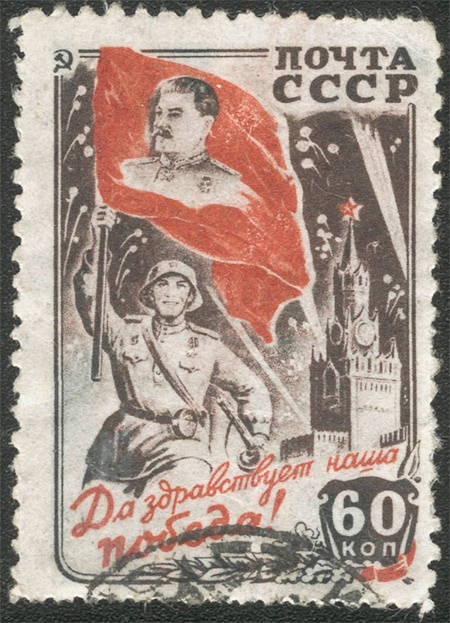
May 1945: The Soviet View
Lieutenant-General P.A. Zhilin, Corresponding Member of the Soviet Academy of Sciences and head of the Institute of Military History/Soviet Ministry of Defence, is an important and imposing figure. Behind him lies both his war record and also an array of substantial works on military history embracing the pre-revolutionary and the Soviet period; not the least of his achievements is his work as deputy editor of the 12-volume Soviet history of the Second World War (lstoriya vtoroi mirovoi voiny 1939-1945, Moscow Voenizdat, 1973-1982). As might be expected, General Zhilin's Institute is closely involved with the Soviet commemoration of the fortieth anniversary of the end of the war in Europe and, by the same token, I was pleased to have the opportunity to exchange views on the significance of this occasion with General Zhilin and others during the course of a visit to the Soviet Union in January of this year.
May 9th – Soviet VE Day – has always held a singular place in Soviet life, propagandistic posturing apart. Brute figures speak for themselves: 1,418 days of military operations June 22nd, 1941 – May 9th, 1945) involved the Red Army in 1,320 days of active operations (93 per cent of the total period of the war in the east). From 1941-44 between 153 and 201 German divisions were committed on the Eastern Front, bringing about the ultimate loss of 10,000,000 German troops, killed, wounded and missing; three-quarters of all German losses. In the course of this conflict Soviet war industry – having accomplished the greatest industrial migration in history with the forced evacuation to the east – produced 95,099 tanks and 108,028 combat aircraft, plus 188,100 guns: with only a quarter of the coal and a third of the metals available to Germany, the Soviet Union produced twice as many weapons and twice as much military equipment; Lend Lease, whose importance the Russians have by no means forgotten, nevertheless amounted to only 4 per cent of the weapons produced by the Russians themselves. In what was a battle for 'metal, war material and food', Soviet workers (so many of them hard-pressed women) turned out 427 million artillery rounds, 17,000,000,000 cartridges and those who toiled in the fields or mines produced 40 million tons of food and 13 million tons of fuel.
This article is available to History Today online subscribers only. If you are a subscriber, please log in.
Please choose one of these options to access this article:
- Purchase a online subscription and receive unlimited access to our archive for one week, one month or a year
- Purchase a print and website subscription, giving you one year's access to all our content and 12 editions of History Today magazine.
- If you are already a print subscriber, purchase the online archive upgrade for a year's worth of access at a reduced price
Call our Subscriptions department on +44 (0)20 3219 7813 for more information.
If you are logged in but still cannot access the article, please contact us
If you enjoyed this article, you might like these:
- Home
- Location
- Period
- Themes
- Magazine
- Subscribe
- Archive
- Ebooks
- Students
- Blogs
- Contact
Newsletter
From The Current Issue
|
Jeffrey Richards
|
|
Jonathan Fenby
|
|
Tom Holland
|
|
Roger Hudson
|
From The Archive
|
The Hudson's Bay Company was one of the central forces moulding the development of the vast tracts of land that today are Canada - but as Barry Gough explains here, the circumstances of its launch in 1670 also reveal much about the commercial forces, personalities and rivalries of Restoration England. |
On This Day In History
Richard Cavendish recalls the death of the pirate William Kidd, executed on May 23rd, 1701.