Jump to Navigation

Changing the House of Lords

Print this article   Email this article

The recent attempt at House of Lords’ reform and the capacity of the issue to do serious damage to the cohesion of the governing coalition invites comparisons with the past, says Jeremy Black.
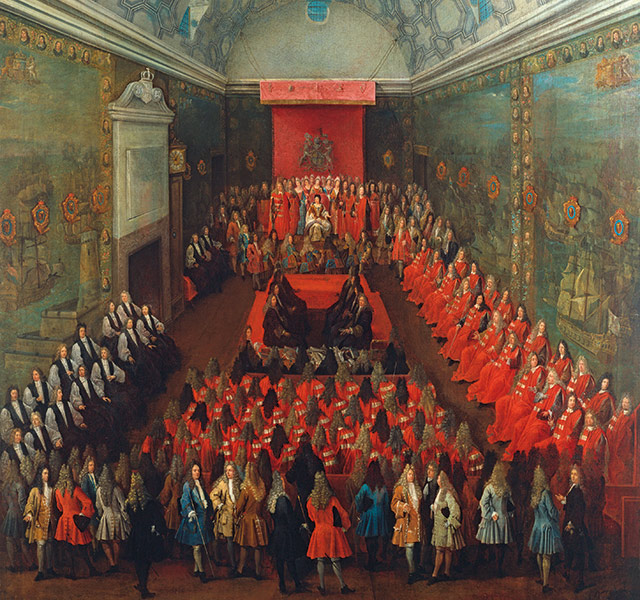
In need of reform? 'Queen Anne in the House of Lords' c. 1708-14 by Peter TillemansThe Peerage Bill of 1719 aimed to transform the composition of the House of Lords to the political advantage of King George I and his supporters. It did not create or threaten to create more peers, a tactic used to ensure the passage of the Peace of Utrecht in 1713 and, later, the Great Reform Act of 1832. Nor was it a case of altering the power of the Lords while not transforming its composition, as with the Parliament Acts of 1911 and 1949. As for the recent proposals, they were clearly designed to ensure that the Liberal Democrats, the governing coalition’s junior partner, had a more prominent role in the political system and, indeed, might have enabled them to introduce a system of proportional representation.
The 1719 measure was intended to preserve the ruling ministry from the threat posed by the heir to the throne, the future George II, and his leading advisers, Robert Walpole and Charles, Viscount Townshend. They were politically opposed to the prince’s father, George I, and his ministers, notably Charles, 3rd Earl of Sunderland and James, 1st Earl Stanhope.

The Bill, introduced into the Lords in March 1719, sought to limit the ability of the future George II to create more peers and thus harm his father’s ministers, notably by impeaching them, as had happened to Anne’s ministers under George I. The bill laid down that, with the exception of royal princes, the King could create only six more peerages and, thereafter, further peers only on the extinction of titles. As a further attempt to lessen the possibility that a future ministry would be able to greatly change the composition of the Lords, the 16 Scottish elected peers were to be replaced by hereditary ones.

Fixing the composition of the existing peerage would therefore serve to preserve the position of the existing ministers and make it difficult for a new government under George II to sweep them aside through control of both chambers.

Having dropped the legislation in April 1719 due to concerns about its chances in the Commons, the government reintroduced the Bill in December 1719. It easily passed in the Lords, where the ministry had a strong position, but was defeated in the Commons in a humiliating blow to the government. Robert Walpole linked Opposition Whig hostility to that of the Tories. He also published The Thoughts of a Member of the Lower House… on the Bill, in which Walpole played on concern among MPs that they might not become peers as a result of the legislation, a factor that cynics might suggest is not so much a consideration in current attempts at reforms, since party placemen can expect high positions on proportional representation lists in an elected House of Lords. Walpole asked MPs if they would ‘consent to shutting the door upon [their] family ever coming into the House of Lords’.

The defeat of the legislation ensured that Britain would not have a closed peerage but, instead, would have one that could respond to subsequent economic, social and political developments. Alongside short-term political considerations in the aftermath of George I’s ill-health in 1718, these longer term points were of lasting importance to the character and health of the British political nation.

Jeremy Black’s books include a biography of George II (University of Exeter Press, 2007).


About Us | Contact Us | Advertising | Subscriptions | Newsletter | RSS Feeds | Ebooks | Podcast
Copyright 2012 History Today Ltd. All rights reserved.