Jump to Navigation

Ireland

EDITOR'S CHOICE

In our final round up of histories of the nations that make up the British Isles – or, if you prefer, the Atlantic Archipelago – Maria Luddy examines an event which shaped 20th-century Ireland, the 1916 Dublin Easter Rising.

To read any piece marked , you'll need a subscription to our online archive

The flight of the earls on September 4th, 1607, was the first of many departures from Ireland by native Irish over the following centuries.

John Horne asks why the heroic efforts of the two Irish divisions, the 16th (Irish) and the 36th (Ulster), in the bloody events on the Western Front in 1916, have been viewed so differently both at the time and since.

Peter Marshall explains how a chance reference in an old local history book led him to reconstruct the story of a 17th-century church scandal, and its afterlife in literature, culture and politics.

Kevin Haddick Flynn looks back at the life and times of radical Michael Davitt as Ireland remembers the centenary of his death on May 31st.

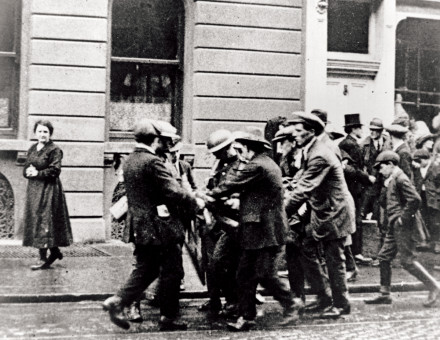
Charles Townshend has read hundreds of 'witness statements' from the men and women who took part in the Easter Rising, made available to the public in 2003 after decades in a government vault.

Anthony Fletcher uses the papers of his artistic great-aunt, who, as a young nationalist, wrote an eyewitness account of the Easter Rising, to explore her youthful patriotism and vigorous activism.

Richard Cavendish marks the demise of an important Renaissance figure, on March 20th, 1656.

Brian Girvin explains the tensions between the Irish government and many of the Irish people in their attitudes to the war against Nazism.

Phil Chapple examines a titanic and controversial figure in modern Irish history.

The organisation which would become the poltical arm of the Irish Republican Army was founded as a nationalist pressure group on November 28th, 1905.

Simon Lemieux shows how a synoptic approach enables us to appreciate the true nature of the Irish Question.

Howard Amos interrogates a key text on colonialism and assesses its influence.

Orla Finnegan and Ian Cawood show that the reasons for Parnell’s fall in 1890 are not as straightforward as they may appear at first sight.

Bill Rolston describes the impact of an erstwhile slave, who toured the Emerald Isle speaking out against slavery in 1845.

Peter Neville surveys the growth of republicanism in Ireland to the present day.


About Us | Contact Us | Advertising | Subscriptions | Newsletter | RSS Feeds | Ebooks | Podcast
Copyright 2012 History Today Ltd. All rights reserved.