
Jump to Navigation

Sir Bartle Frere and the Anglo-Zulu War of 1879

By D.P. O'Conner | Published in History Review 2004 
Print this article   Email this article

Damian O’Connor examines the motives of the man who started the conflict.
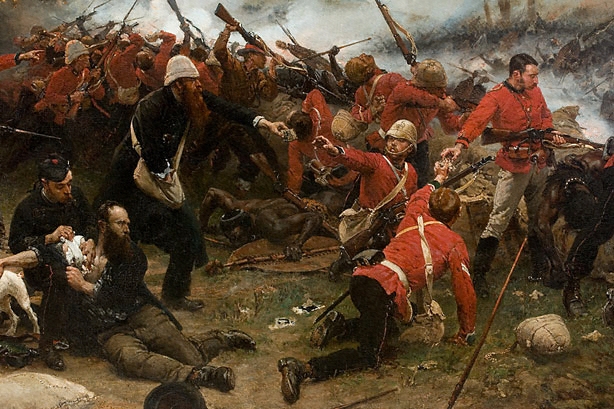
Detail of a painting depicting the Battle of Rorke's DriftThe film Zulu has made the Anglo-Zulu war of 1879 perhaps the most well-known colonial campaign of the Victorian era. The war is also known to students because the British defeat at Isandhlwana contributed to the downfall of Disraeli’s ministry in 1880. To explain how the conflict started, historians have traditionally concentrated on theories of capitalist exploitation and missionary imperialism, but these are now being challenged by revisionist historians.

Economic Motives?

In economic terms, South Africa was simply not worth the effort of conquest, as before the discovery of gold in 1886 the region was poor and unpromising – total Cape imports and exports were valued at £7.5m in 1880, while Britain’s exports alone came to £286m. What economic interests were at stake were offshore, in the £190 million annual trade that went around the Cape, and so territorial control beyond Cape Town was not necessary for its protection. It should also be noted that as a land-grabbing exercise the war was a spectacular failure as Britain handed back control of the country to the Zulus at the end of the war. As for the argument that Zululand was needed as a source of labour, this does not stand close examination – the Zulus had a lucrative business in supplying Tsonga labour to Natal and it was always far easier and cheaper to import Indian indentured labour than to fight a war. As to missionary motives, the main exponent of ‘missionary imperialism’ in Natal was Bishop Colenso, but his influence was limited by his unpopularity among the colonists.

Frere and Imperial Strategy

There is no doubt at all about the immediate responsibility for starting the Zulu war – it was the work of Sir Bartle Frere, British High Commissioner, who ignored repeated orders to refrain from starting the war. He could have stopped it or delayed it but chose to go ahead, even though he knew that it was beyond any acceptable discretion he could expect to wield. What is all the more remarkable about this disobedience was that Frere was not at all a ‘bully in a black hat caught with a smoking gun in his hand’, as Marxist historians have stereotyped him.

A cursory reading of Frere’s career in India makes this clear. Among his achievements were the rebuilding of Karachi and Bombay, the founding of universities, major irrigation schemes and sanitary reforms. His spell as Governor of Bombay (1862-7) has been described as ‘legendary’, while he was also responsible for the abolition of the East African slave trade.

 There were, however, a number of key traits in Frere’s personality developed from his Indian experience. Firstly, he believed that in any given situation, the man on the spot was the best person to decide on a course of action, and that it was the duty of superiors to judge only by the results. Secondly, he held most politicians in contempt, deploring ‘politicking’, and suspected that they were more loyal to party rather than the Crown. Thirdly, he was convinced that the British Empire, during the Balkan crisis of 1876-78, was very vulnerable to Russian attack in a way that it had not been previously due to advances in railway construction, the development of mass conscript armies on the Prussian model, the opening of the Suez canal and the revolution in naval architecture, as steam and iron took over from sail and wood. Frere reached this view when drawing up plans for defending India in 1874.

Previously it had been assumed that South Africa was secure because of its isolation and because of the dominance of the Royal Navy; but the naval revolution threw up a new threat which came from Russian cruisers and privateers. These were fast, lightly-armed steamers which, for technical reasons, were able to outrun the more cumbersome ironclads that made up the main force of the Royal navy and which were designed as commerce raiders. In short, they were the 19th-century equivalent of the U-boat. During the American Civil War the Confederate cruiser Alabama sank 43 Union ships in places as diverse as the north Atlantic and the Bay of Bengal. Defence thinkers at the time were of the opinion that, in time of war, the Russians would not only use the commerce raiders but would also launch raids by a force of 4,000 marines mounted in fast steamers designed for the purpose.

The Colonial Secretary, Lord Carnarvon, motivated by similar fears, wanted to confederate all the weak states and colonies of South Africa into one large pro-British bastion, like Canada. This was especially important if war with Russia were to break out and the Suez canal be closed, as South Africa would then become a vital point on the route to India. However, events ran out of control before Frere ever got to South Africa in 1877 and his policies were really reactive throughout his time there.

African Conflicts

For one thing, the South African peoples were too divided over questions of race and land to be confederated. Worse than this was the fact that Cape Town was ‘utterly defenceless’ and the Russians knew it. A few years previously the Russian navy had visited Cape Town and the officers had boasted that, in the event of a war, they would raid it and then head for their ports in the Far East to escape any pursuit. Frere had to beg spare guns off passing Royal Navy vessels to make even a temporary defence. Nor could he get advanced warning about a raid because he had no telegraph to London, despite repeated requests for one. To make matters worse, three weeks after his arrival in Cape Town the Russians declared war on Turkey and sent their armies into the Balkans.

The question of defending Cape Town from external threat, therefore, was Frere’s top priority throughout his time in South Africa, in 1877-80, and he produced or contributed to seven separate defence reports. Under these circumstances, the last thing that Frere wanted was a war with the Zulus – indeed, he wanted them in a projected African Imperial army.

On arrival at Cape Town he also learned that Theophilus Shepstone had annexed the Transvaal on behalf of Britain. This was important for two reasons. Firstly, the Boers of the Transvaal were very unlikely to accept annexation and would be very likely to revolt as soon as they felt strong enough. Secondly, the Zulus and the Transvaal were locked in a border dispute and Shepstone, who had previously supported the Zulus, now backed the Transvaal’s claims. The Zulus had looked on the British as allies against the Boers but now, feeling betrayed, they began to take a more robust attitude to both the Boers and the British. Frere saw the danger immediately and began to have nightmares about a simultaneous Zulu war and Boer revolt, as well as the possibility of Russian naval attack.

As if this was not bad enough, the Xhosa people of the Transkei revolted in August 1877, and Frere was forced to spend most of the next year putting the uprising down. No sooner had this been done than in July 1878 an incident occurred near a little mission station on the Zulu border called Rorke’s Drift. This was to seal the fate of the Zulus.

On a dark chilly night, two Zulu women fled to the sanctuary of British-ruled Natal, escaping from certain death at the hands of their husband, the powerful Chief Sihayo, who had discovered their lovers. Gossip and ugly rumours followed but Sihayo, mindful of British power, decided to take no action. If he could swallow such a humiliation, however, his fiery son Mehlokazulu could not, and gathering up a war party he dragged his terrified victims back into Zululand to be executed.

This came as a final straw for Frere. The Empire in South Africa could never be safe if the Zulu King Cetshwayo was unable to prevent any of his 40,000 warriors from violating its borders at will. If Britain intended to hold South Africa in the event of a Russian war then it was necessary to publicise this by taming the Zulus.

British Politics

Frere needed troops to start a war and requested the new Colonial Secretary, Sir Michael Hicks-Beach, who had replaced Lord Carnarvon in January 1878, to send them. Hicks-Beach was young and inexperienced in colonial affairs and his attitude to Sir Bartle was simple: he would give a free hand to the ‘man on the spot’. Hicks-Beach needed the permission of Prime Minister Disraeli and the Cabinet, however, and on 12th October 1878 the Cabinet refused to sanction the use of troops.

Although in July 1878 the Berlin Congress had ended the Balkan crisis, the Russian army had refused to leave their positions and were still within striking distance of Constantinople until August 1879. For every gung-ho officer with a cavalier attitude to orders in Britain and India, there was a corresponding empire-builder in St Petersburg. It was therefore impossible to ignore the fact that the Russian army was within a day’s march of Constantinople. At the same time, in September 1878, a Russian diplomatic mission arrived in Afghanistan, and it looked likely that there would be a war there soon. Faced with the possibility of war on two fronts, Disraeli was against diverting troops to a third theatre.

This turn of events immediately sent Hicks-Beach into a panic, as he realised that Disraeli and Salisbury, the leading men of the party, did not share Frere’s fears that the global nature of the Russian menace extended to an immediate threat to South Africa. The Colonial Secretary was therefore dangerously out of political step. He had so far agreed with all that Frere had done. But despite his inexperience in colonial affairs, he was an experienced enough politician to know when to tack with the prevailing wind: he now changed his mind and ordered Frere not to attack the Zulus – although he still sent the troops.

Conclusion

For Frere, the order from London came too late. He had already ordered that an ultimatum be presented to the Zulus, on 11th December 1878, to hand over Mehlokazulu and disband their army – or else the British army would come and disband it for them. To pull back from a confrontation now would simply convince the Zulus that the British were afraid of them, he thought, and that would encourage them to solve their border dispute with the Transvaal by sending their impis in. He guessed that Hicks-Beach had changed his mind out of political cowardice.

Frere thought that the best way to resolve the situation was to ignore Hicks-Beach and rely on the British army to deliver a quick victory, which would make British control of South Africa certain and secure the Imperial lifeline. And so he took the fateful decision to disobey the government and invade Zululand. Frere did not start the war in order to annex Zululand or to free up its resources for white exploitation, as has often been claimed, but to ensure the security of a vital link in the chain of imperial stations in advance of a global war with Russia that he was convinced was about to break out. It is tolerably certain that had things turned out differently at Isandhlwana, Frere’s action would have been condoned and his disregard of orders from his political master relegated to a footnote in the history of the British Empire.

Further Reading:

  • J.C.R. Colomb (ed), The Defence of Great and Greater Britain (London, 1880)
  • R.L. Cope, Ploughshare of War: The origins of the Anglo-Zulu War of 1879 (Pietermaritzburg, 1999)
  • J. Laband, Rope of Sand (Johannesburg, 1995)
  • J. Martineau, The Life and Correspondence of the Rt. Hon. Sir Bartle Frere (London, 1895)
  • D. R. Morris, The Washing of the Spears (London, 1965)
  • D.P. O’Connor, The Zulu and the Raj: The Life of Sir Bartle Frere (Knebworth, 2002)
  • D.M. Schreuder, The Scramble for Southern Africa, 1877-1895 (Cambridge, 1980)
  • D.M. Schurman,Imperial Defence 1868-1887 (London, 2000)

D.P. O’Connor is Head of History at Gosfield School in Essex.


About Us | Contact Us | Advertising | Subscriptions | Newsletter | RSS Feeds | Ebooks | Podcast
Copyright 2012 History Today Ltd. All rights reserved.