Jump to Navigation

Roman Empire

From 27 BC Rome and its territories were ruled by a series of emperors, beginning with Augustus. By the 2nd century AD the empire covered about 13 million square kilometers (5 million square miles... read more

EDITOR'S CHOICE

Keith Hopkins shows that gladiatorial shows in Ancient Rome turned war into a game, preserved an atmosphere of violence in time of peace, and functioned as a political theatre which allowed confrontation between rulers and ruled.

To read any piece marked , you'll need a subscription to our online archive

Richard Cavendish marks the anniversary of this great emperor's accession, on March 8th, AD161.

Richard Cavendish remembers the death of Emperor Septimus Severus on February 4th, 211.

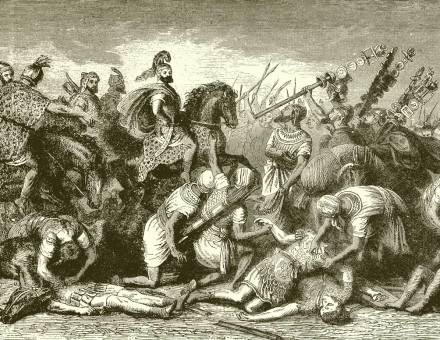
Little remains of the great North African empire that was Rome's most formidable enemy, because, as Richard Miles explains, only its complete annihilation could satisfy its younger rival.

At the height of the Roman Empire, hundreds of merchant ships left Egypt every year to voyage through the Red Sea into the Indian Ocean, exchanging the produce of the Mediterranean for exotic eastern commodities. Raoul McLaughlin traces their pioneering journeys. 

Richard Cavendish remembers the event that signalled the beginning of the end of the Western Roman empire 

Did the first Christian Roman emperor appropriate the pagan festival of Saturnalia to celebrate the birth of Christ? Matt Salusbury weighs the evidence.

John Haywood explains why the tactics adopted by the Gallic leader Vercingetorix to resist Julius Caesar’s conquest of Gaul played into Roman hands.

As the Roman Empire declined its leaders became interested more in personal survival than good governance. Sound familiar? Adrian Goldsworthy draws comparisons with current crises.

Anthea Gerrie explores a remarkable excavation, a Roman surgeon’s house in Rimini.

China and Rome were the two great economic superpowers of the Ancient World. Yet their empires were separated by thousands of miles of inhospitable terrain, dramatically reducing the opportunities for direct communication. Raoul McLaughlin investigates.

Published in History Today, 2007

Two thousand years ago, the greatest of dictators was slain. Julius Caesar was, paradoxically,the constitutional head of the Roman state. The question of how he meant to use his supreme power has ever since been disputed, writes R.A.G. Carson.

Charles Freeman visits the Eternal City, and finds the Castel Sant’Angelo, home to emperors and popes, to be the clue to unravelling its fabulously rich and complex history.

Marius Ostrowski explains why the Church was so dominant in the Middle ages, but also sees traces of a growing secularism.

Published in History Review, 2006
Anthony Grafton remembers Theodor Mommsen, the great German historian of the Roman republic and literary giant of his day.

Romans have reacted passionately to the new presentation of one of the Eternal City’s key historic monuments, Charlotte Crow explains.


About Us | Contact Us | Advertising | Subscriptions | Newsletter | RSS Feeds | Ebooks | Podcast
Copyright 2012 History Today Ltd. All rights reserved.